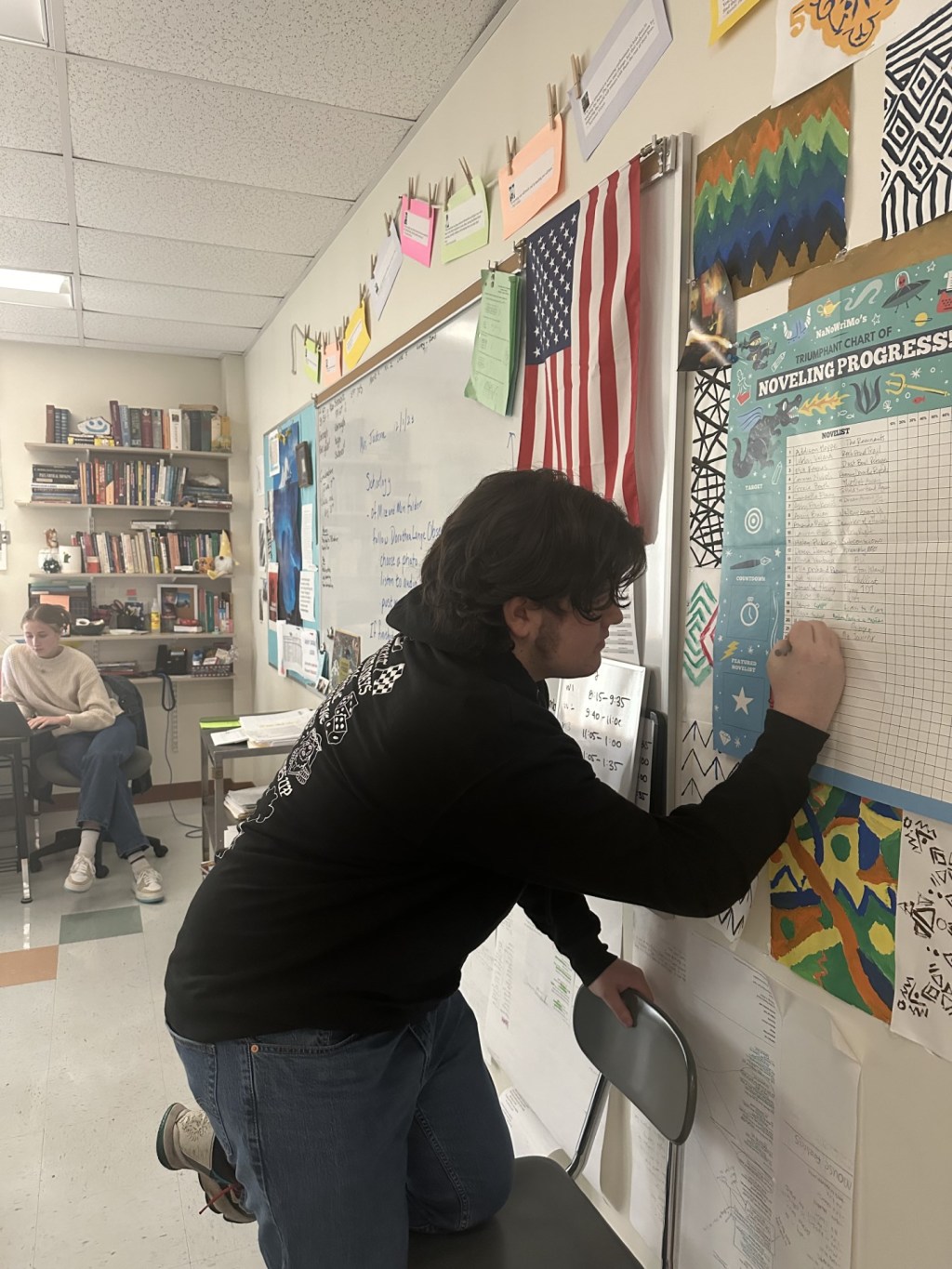
The Remnants, Rock Pond Trail, Running Down the Riptide, Star Island, Rift. These are just some of the titles that current students in room T106 stare at quizzically. What those students may not know, is that they’re titles of past novels completed by former students in Marjke Yatsevitch’s classes during NaNoWriMo.
November was National Novel Writing Month (NaNoWriMo), and around the school, students were on a quest to hit their word goal by engaging in a regular creative writing practice. Many of these students are enrolled in either Fiction Writing or Advanced Writing and are taking part in NaNoWriMo as part of these courses. Now that the month is over these students are grateful for having had the opportunity to write for these classes where the grade isn’t based upon their writing skills.
NaNoWriMo, here in the building, began with each student creating an account on the Young Writers Project subsection of the NaNoWriMo website. In order to come up with their word count goal they wrote for a set period of time and then the number of words written in that period is multiplied by the number of minutes they would ideally spend writing over the course of the month, and that total became their word count goal.
This was English teacher Marjke Yatsevitch’s 7th year including NaNoWriMo in her course curriculum. The idea initially came from Kathy Pearce, former ORHS librarian, who always made sure that students and teachers were aware of the multitude of extended learning opportunities and supported teachers in implementing those into their classrooms.
Yatsevitch went on to explain that it’s an amazing chance for students to learn to accept imperfection because it’s not so much about having a perfect story with proper editing, but about writing and the number of words. “What I love about it, is that it creates an open-ended space for creativity as opposed to something that’s entirely structured by each individual step. It was an opportunity for kids to take on a big project, but the expectation wasn’t necessarily that they had to finish their novel,” said Yatsevitch. She went on to highlight the incredible work students have done, including some who have published the works they began during NaNoWriMo. These published works include two pieces by Eva Raynes entitled “Dust Bowl Refugee” and “The Chellist.”
Yatsevitch continued by explaining the multitude of ways students write their stories during NaNoWriMo with some begin at the beginning and write all the way through, some begin at the climax and work from there, and some spend time making outlines of things they want to include before beginning the full writing process. “It’s more about gaining fluency [through] a daily writing practice and that open-ended space.”
One of her advanced writing students, Saketh Kantipudi (‘24), said he’s “not really writing about anything. I’m writing about everything from a philosophical standpoint.” He used NaNoWriMo to “maximize the efficiency” of this period in his life, where he’s thinking about what he wants to do in the future and his thoughts and beliefs on various topics.
Kantipudi is writing a variety of short stories, essays, and vignettes in order to reach his word goal. His main strategy is whenever he thinks of an idea, he will write it down somewhere and get to work writing later in the day when he feels he has the time to devote to the project. His most recent work has been thinking about the prison system and the morality behind incarcerating people.
Jacob Failla (‘24), also known as WritingMaster1606, is in Yatsevitch’s Fiction Writing course this semester and has been working on his novel. Failla was off to a slow start but after changing his story idea he was able to get more into it. Initially, his stress came from feeling like he wouldn’t have enough words but felt that if he got writing that stress would be lifted. Initially Failla was writing a fictional piece entitled “The Journey to Bangkok” but now isn’t entirely sure exactly what his story is about.
Another one of Yatsevitch’s Advanced Writing Students is Logan Savage (‘24), who was working on his second novel after finishing his last year in Fiction Writing. Last year Savage wrote about a musician who overnight became an international sensation, and “doing [NaNoWriMo] again definitely makes me realize that the consistency to it is really the key to getting it done.” His current story is a hodgepodge of ideas including a commoner girl who gets special powers in a world where the powers are supposed to be reserved for the people of wealth.
Savage’s writing process is just to put whatever he thinks of on the page and at the end of the day he goes through it and makes edits in order to find where he really wants his story to go. Savage, like many students, has enjoyed the process of writing without focusing on the grade feeling as though he has had a chance to explore his creativity.
As the month of November has now come to an end, there is no reason why we can’t all embark on a writing journey, even if it’s not part of NaNoWriMo. Savage said it best saying, “as long as you’re consistent, anyone can [write a novel].”
– Delaney Nadeau
 Mouth of the River
Leave a Reply