
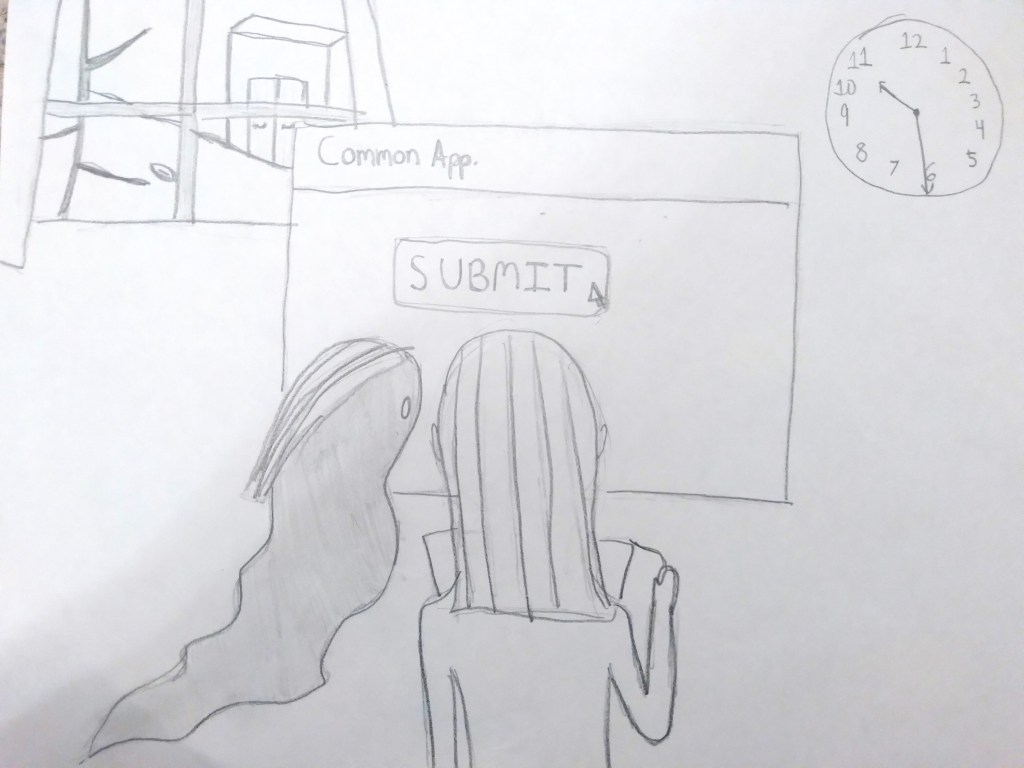
It was a dark and stormy night and with every tick, the minute hand inched closer to midnight. At the same time, the Early Action deadline loomed. A student stared at their computer screen, frozen on Common App as they nervously hovered over the submit button. They suddenly felt a presence peeking over their shoulder, whispering You should’ve listened to me…I raised you; I know what’s best for you.
College admissions are a stressful time for students and part of that may be how their parents act alongside them through this journey. College applications are supposed to focus on the student’s voice and their accomplishments, rather than what their parents want them to be seen as. Student comparison also has a large effect on how students feel when they’re preparing for college.
The amount of support a student wants to receive regarding college applications may vary based on their own strengths and weaknesses. Heather Machanoff, a counselor at Oyster River High School (ORHS) recognizes that there are some students who prefer to be more individualistic when it comes to applying for college. She says, “For students who are more independent minded and like to do things on their own, might think it’s a little bit too much and it might be a little bit stressful to have your parents breathing down your neck.”
Machanoff herself was a first-generation college student, coming from a family of farmers and a smaller high school. She didn’t have as many opportunities as we do now. But her parents nevertheless supported her, even though they never experienced the college application process.
On the other side of the spectrum, there’s Erin Turnbull (‘24), whose parents (especially her mother) are very supportive and involved in her pursuing college. Her mother has a past of being a career counselor and still works in higher education.
Her mother states, “I think what has influenced Erin the most is that I’m very good at researching the current environment of the colleges [she] is applying to. It’s very competitive. I encouraged her to take the hardest classes she can handle to reach her full potential. She’s a very motivated child, so it hasn’t been too hard to do that.”
Turnbull agrees that her mother is very proactive in the college application process. Her mother is always looking for ways to improve her application, give her ideas for essays, and is truly excited for what is coming up in her child’s future.
However, at times Turnbull has felt that she has been receiving too much parental guidance, although she recognizes that they usually try to stay in the boundaries she lays down.
Turnbull says, “I think it’s nice to be supported. Sometimes it can feel like they’re too involved, and they never let me have the chance to just do things by myself without having to be reminded all the time.” This can also mix in with important college application milestones, like writing essays. Turnbull recalls that her parents would give her many ideas for college essays, some that if she wrote, wouldn’t even sound like herself.
Being able to be her true self on her college applications has been Alja Forcey-Rodriguez’s (’24) biggest motive in the process. Her family has a more humanities-based background, especially with her mother as a humanities professor.
Although Forcey-Rodriguez wants to major in a different field than what the rest of her family have done, her parents have always supported her through the application process. Forcey-Rodriguez states, “They never pressured any of us into a certain career path or a certain college…” They just wanted us to get it done and to give us the best chances at being where we want to be.” Her parents deviated from being more authoritative with her college applications. They trusted that she knew herself and what she wanted to pursue.
Parents may act more authoritatively over college applications because of the lack of opportunities or guidance they had when they were growing up. Lucky Muppala (‘26) is a sophomore, but still has felt the pressure to get into a good college for a long time. Her mother is the one that’s mostly academically pushing her. “She’s really pushing me to have a career you can make a lot of money in. You have time, and you can do anything you want with that thing. She just wants me to have a stable life,” she said.
Higher education is a priority for both of Muppala’s parents as both worked extremely hard to get in and pay for college back in India, their home country. In there, it can often be harder to get higher education if you’re a woman, which is why Muppala’s parents are so motivated to have her go to university.
Forcey-Rodriguez also uses her family’s background, especially her mother’s, as a way to motivate herself. “My grandpa actually came from Cuba when he was 12 to America and then kind of was able to work his way up,” she said. “[He] became a professor and went to grad school. I think seeing that my mom’s side of the family, which was a lot more immigrant oriented, it’s a big part of their identity as people who came here and are sometimes treated like they don’t belong.”
Turnbull’s mother also puts emphasis on the fact that applying to university is the time for the individual applicant to really shine, not their parents. Her mother says, “It would be very easy for me to take over, but it has to be in her own voice. I think it’s important that her own voice, who she is, comes out…” She tries her best to let her daughter have the main voice during the journey and although she may try to persuade her into potential application ideas and schools, it is Turnbull’s decision at the end of the day.
Muppala has noticed that her parents have tried to persuade her to be the best for her college applications. This encouragement can sometimes turn negative and toxic. She says, “There were definitely times where I felt pressure from them that I have to do good in all my classes, be a part of class officers, NHS [National Honors Society], especially because you’ve seen a lot of Asian kids be like two years ahead of math…I feel like I need to do good because of these other kids my parents are comparing me to.”
Turnbull’s mother has seen how competitive parents can be when it comes down to getting their child into those top tier schools. She recalls that at this year’s open house, the parents in some of the AP classes were only really concerned about how their child can take extra AP exams, not what was being learnt in class. Although she does want her daughter to do well, she still places a lot of importance on truly learning for yourself, not to just go to a good school.
Turnbull was also pushed as a child, like Muppala, even before college was something she thought about on the daily basis. She remembers, “In middle school, my mom tried to push me ahead in math classes and stuff like that, but I just want to stay with my friends, I want to stay with the people in my grade. But once I started sophomore year, where you can start taking advanced classes and choosing more…My parents would say, take the hardest classes you can take and do well.” This mindset has been a large part of her academic life.
Turnbull realizes that her mother really just wants the best for her and the future. She says, “I think it’s coming out of a good place because she just wants the best for me, and she always says to me, ‘this is a really important time in your life to make a lot of opportunities for yourself’.”
Her mother’s biggest motive for Turnbull is that she just wants her daughter to be happy and be confident with the choices she has made and will continue to make for her future. She states, “I want her to have choices in life, I want her to reach her full potential. I know that my education provided me with opportunities for my own life and I want her to have the same.”
– Hannah Klarov



 Mouth of the River
Leave a Reply