
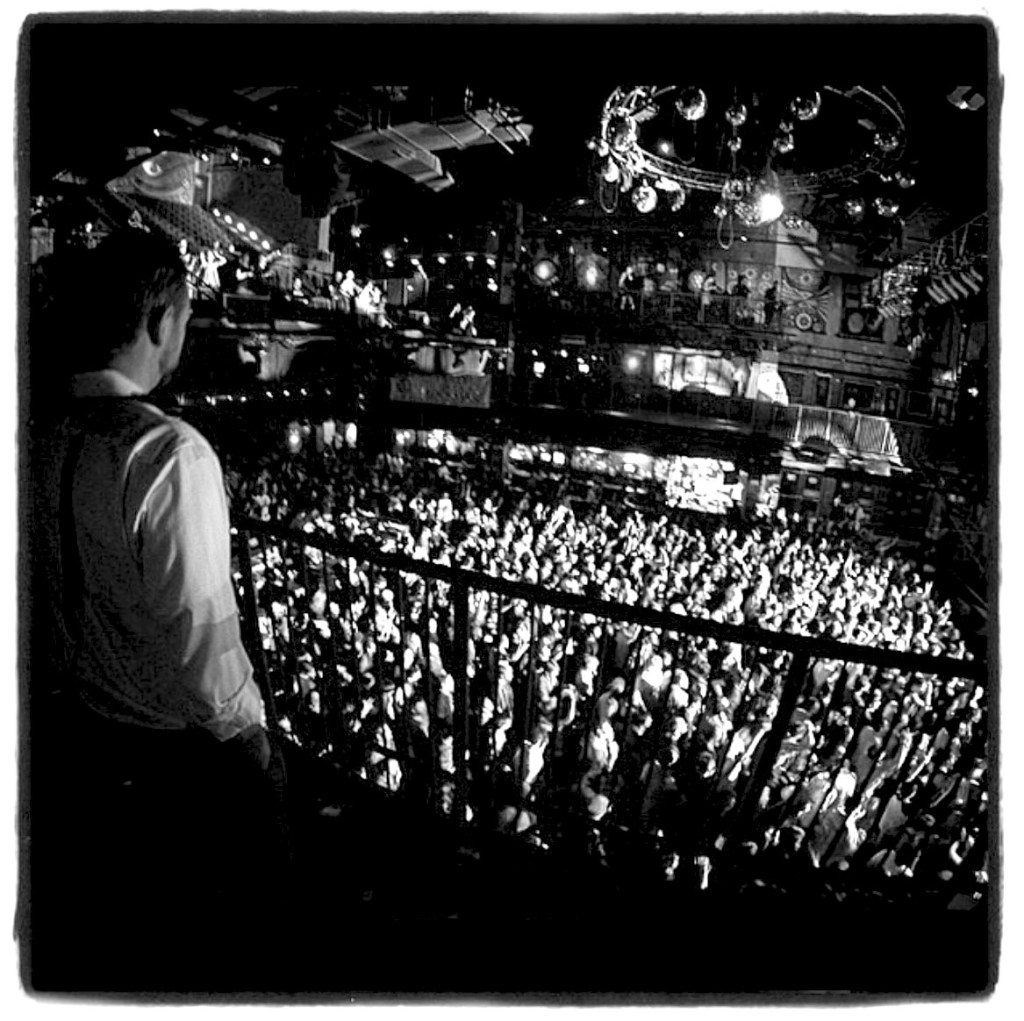
Sitting in Adam Lacasse’s classroom, you’ll see students sitting in massage chairs, plants hanging from the ceiling, and records and posters from a few of the thousands of bands he’s seen. He’s sitting at his desk throwing a stress ball back and forth with a student, talking about the time he lost his hearing for several days after hearing Motörhead or the time he saw U2 play in Rome.
As one of Lacasse’s advisees, I’ve always known he used to work at concerts, but I’ve been curious about how he started, what he learned from working at crowded venues, and how he became a teacher from there. I was also curious about some of his stories while working at concerts, and what he plans to do after teaching.
Lacasse originally went to the University of New Hampshire (UNH) for an associate degree in science and business management, where he was a part of a fraternity. It was at this fraternity where he first experienced helping plan and organize events. He liked helping with these events so much, he applied to the Casino Ballroom in Hampton, NH, where he worked for fourteen years and ended up becoming the Director of Operations.
“When I worked in Hampton, we did anything from comedy to food shows to sit down shows to stand up rock shows to a little bit of everything,” said Lacasse on his experience at the Casino Ballroom.
Working in Hampton, Lacasse started at the bottom as a barback before working his way up over the course of the fourteen years, and he has advice as to how he did it. “When I was in Hampton, I missed three shows over the period of fourteen years. Essentially my word to a lot of people is if you want to move up in a place you’ve always got to be there and available.”
From Hampton, Lacasse moved up to the House of Blues in Boston, one of the more well-known concert venues in the area, where he worked for just under a year. He applied years prior to working there but had to turn down an offer. “They wanted to bring me in for an interview for it, but the pay wasn’t what I was expecting so I said, ‘thanks but no thanks,’” explained Lacasse. “Several years later they reached back out to me to be the Director of Music Hall operations, and that pay was a lot more money than I was making so it was kind of hard to say no.”

As soon as Lacasse began working at the larger venue, he realized the environment wasn’t one he wanted to be in. He explained how at Hampton, everyone was supportive of each other. “House of Blues was kind of the opposite. […] For me it was a very toxic, unorganized place where I don’t know if I was ready for them, or they were ready for me, but it wasn’t really a good strategic fit.”
He understood he had the potential to change the environment, and make it one everyone wanted to be in, himself included. “At the end of the day I was hired there to help restore it. […] When I got there, House of Blues was chronically understaffed and overworked, […] so my first thing was just to hire people. I essentially doubled the size of the workforce there within three months.”
At the House of Blues, as the Director of Operations, Lacasse was in charge of everything going on in the background, from hiring and managing staff, to coordinating events, and budgeting. According to him, he was “essentially just the man behind the scenes that made the magic happen.”
Working in concert venues has given Lacasse some unique experiences. “Not everyone gets to meet Snoop Dogg or George Thorogood, Eddie Money, or comedians like Ron White or Lewis Black.”
Lacasse has also collected a variety of life stories from working at the venue. “I was hired there, I worked there for a few months, then they told me, ‘Oh yeah on Saturday nights our shows are out at 10:00pm and from 11:00pm until 3:00am (while he wasn’t working) we turn into a gay nightclub. So I’m like ‘oh you’re telling me I run a gay nightclub too now?’ So put that into my resume,” said Lacasse.
Over the course of his lifetime, Lacasse has seen exactly 1046 concerts, his favorite being a festival with Elton John, The Rolling Stones, and The Eagles, and his least favorite being an undersold ABBA cover band. From his time in the industry, he’s gotten to meet some amazing talents, and he’s always been fascinated with how different artists compose themselves. “Some artists stay on their bus, and they don’t want anything to do with anyone until they get up and go onto the show, and there’re some who just walk around and say hi.”
His transition between concerts and teaching was a quick turnaround, and his life changed entirely within a few months because of it. He had always had an interest in teaching, and his past experiences aided him. “I was an adjunct professor at UNH at the same time I was at Hampton, so I taught Operations Management, which is my background. I also taught at the Thompson School of Applied Science; they had a business program there for a while. It was always kind of teaching. I always thought that was going to be part of who I am.”
When Lacasse realized he was ready to be done with the stress and toxicity of the House of Blues, he made a big decision and turned his career around. “When things didn’t work out in Boston, I took about two months off in the summertime with my kids and really thought back. I called my old boss at the Thompson School, and I asked her: ‘Hey, I’m looking for work.’ and she’s like: ‘I don’t have anything, but [Oyster River] High School does.’”
From there, it was easy for him. “She called me back 20 minutes later and I got an interview, second interview the next day, and then I was hired, and school started two days later.”
Lacasse is glad for the change that he made because now he has more opportunities to spend his time how he wants. “Now I have a life with my children, so that was really important to me.”
Many know Lacasse for his flexible teaching policies, many of which he learned through working at concerts. At the House of Blues, Lacasse got the opportunity to work amongst a diverse team and has learned and matured from that.
Students know Lacasse for his flexible policies on tests and teaching. Greg Caron, one of his previous students, said this has helped him move from high school to college level economics classes. “He definitely teaches more in a manner that’s college like, instead of high school.”
He also hopes to inspire his students to become responsible, friendly people. “I’m here to mentor people, and at the end of the day I could try to teach people something, but if I can teach them how to be a good person and treat people with respect, I think it goes a long way.”
Lacasse has been teaching at Oyster River High School since, and this is his ninth year. “Right now, I’m in a happy good place, I’m teaching exactly what I want to teach,” he said. He plans to stick around Oyster River for several years but is certain he’ll move on soon enough and see where life takes him
-Micah Bessette
 Mouth of the River
Leave a Reply