
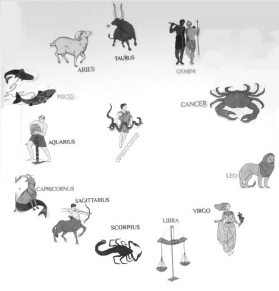
Scrolling on TikTok, colorful and aesthetically pleasing videos pop up one after another: Lip shapes according to zodiac signs. Then the next video: Dark academia vs light academia zodiac signs. Even on Snapchat, each profile has the option to show someone’s birth chart to anyone who taps on it. Is a person’s fate really written in the stars?
Zodiac signs are a cultural subset that helps those who believe find out more about themselves, the future, and everything in between. The common astrology that we see today has strayed away from its original meaning, over 3000 years ago. But are zodiac signs just fun little stories to entertain people or are they at the core, a cry for help in a meaning-deprived world?
To put it simply, zodiac signs are stories derived from constellations. There have been multiple cultures that have first sighted these constellations, but the earliest one was the Babylonians.
If cultural influence from zodiac signs is big now, it was twice as large, back then in around 410 B.C.E. – more than just a button showing you’re a Taurus on your Snapchat profile.
“History of the Zodiac”, a journal article by B.L van der Waerden, describes the direct origin of these signs and how big of an influence they were.
Van der Waerden writes, “All pseudo-physical arguments by which astrologers try to make plausible the influence of planets and zodiacal signs upon our lives, are only disguises, the primary idea being that the planets and signs are Divine Powers. The accomplished system of astrology with its vague religious background…could originate only in a country where the stars, planets and zodiacal signs were worshipped as gods, i.e., in Babylonia.”
These stories were more than just entertainment at the core level, they were a connector between people and the higher beings they worshipped.
Sara Cathey, Oyster River High School (ORHS) science teacher, can’t imagine not teaching her Astronomy class at least a little about these stories. She says, “What’s fascinating, is that different cultures have zeroed in on this one cluster of stars, and they’ve attached their different stories to it.” Cathey introduces the concept of astronomy by explaining the differences between astronomy and astrology.
Isabelle Alix (‘25), a student in Cathey’s astronomy class, has never found the reasoning behind astrology to be logical and thinks that it shouldn’t be used to influence someone’s life. She states, “It’s just something that people did to make themselves feel better, and the whole thing with reading your horoscope in the newspaper, it’s just you letting other people make decisions for you.”
While some people let zodiac signs run their lives, Eden Suoth, a social studies teacher, thinks about it from a philosophical perspective. “My immediate reaction is to wonder if it’s been completely co-opted by this culture to serve as a meaning generator, because we’re so starved and deprived of meaning.” Zodiac signs can serve a meaning to people’s actions, why they do certain things, just like how the Babylonians relied on the stars as gods.
Suoth also brought to light a philosophy attributed by Friederich Nietzsche, the philosopher’s most well-known quote attributing to the lack of belief in God. Nietzsche saw the world becoming more and more secular, a world far apart from once God-revolving communities. So, in his theory, we have loosened our transcendental belief around God, putting us in a “crisis of meaning.”
This theory in turn proposes that zodiac signs replace that need for believing in a higher power, something beyond us to guide people through their lives. Cathey, although not a firm believer of Western astrology, finds it interesting that people base traits, actions, and emotions on the positions of stars.
She states, “And so, is that my personal belief system? No. But I find it really interesting because what an interesting phenomenon to hang your hat on and help with your life and your actions. I find it fascinating that people do that.”
Paige Haug (‘25) has always been interested in zodiac signs and thinks they do have some truth to them spanning our culture. “It’s not always accurate because somebody could have the same exact [sign] as you and it totally not be accurate. They just have different personalities. Like they couldn’t answer with a bunch of the same stuff that you answer with.”
When the Babylonians invented zodiac signs, the stories were much more elaborate, compared to the current reduced tropes.
Odin Whiteley (‘25) believes that these overused stories have made it harder to believe in astrology. He says, “I think it’s a lot of coincidence and vague descriptions of basic personality traits that can fit almost anyone. But when you know your zodiac sign, I feel like a lot of people tend to act more like that as their personality.”
Since the first time the Babylonians laid their eyes on the stories surrounding the stars and started making their first horoscopes, the Earth has changed, both culturally and physically. In 2006, NASA made the discovery that our planet tilts every 1600 years, meaning each of our current zodiac signs are not our actual signs.
The zodiac system was set up 3000 years ago, already aligning with the clusters of stars that were there before. Cathey says, “The wobble of our planet has caused us to be out of that alignment. The physics of our planet is now saying our zodiacs don’t line up anymore. And the world basically said, ‘nope, sorry, we’re not believing’…We’re further along in our wobble on our planet, so I’m no longer an Aquarius. I’m now a Capricorn.”
But even then, what do zodiac signs represent in the bigger picture? A gap in our own perception of life? A hole to fill? Suoth states, “That’s where my unease comes from when people use these things as a way to not take a deep and honest look within their own selves. We lean more into astrology, for an example, rather than trying to figure out how in the secular world, we can make meaningful lives for ourselves.”
– Hannah Klarov



 Mouth of the River
Leave a Reply