
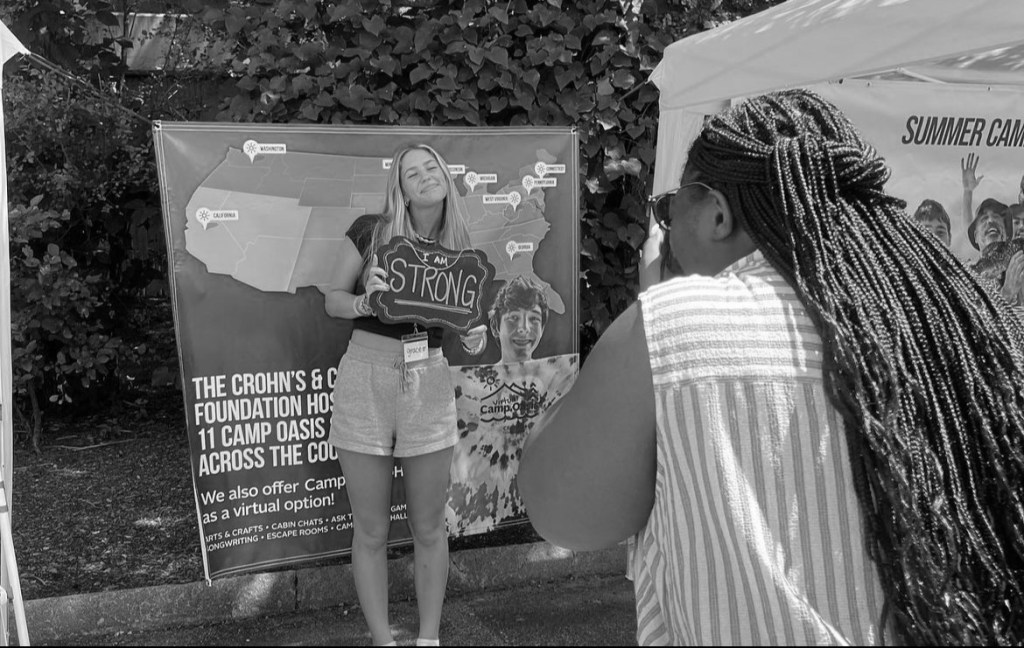
Grace Kasper (‘25) has heard “you don’t look sick” far more than the average person. She hears it when she has to explain why she’s missing school, or what she’s eating for lunch, or why she says she’s tired no matter how much sleep she got the night before.
To the average person, no, she doesn’t look sick. Not in the way they’re picturing. But they aren’t seeing the girl who spent most of her fourth grade year in the hospital. They’re not seeing the hundreds of google searches her mother made before the diagnosis. They don’t know what Ulcerative Colitis looks like.
Ulcerative Colitis is chronic disease, a form of inflammatory bowel disease, or IBD. It’s a piece of a disease trifecta, encompassing Crohn’s disease and diverticulitis. Everyone with any of these diseases experiences them differently, but in Kasper’s case it’s presented as a cycle. She’ll experience flares, in which symptoms are heightened and severe, as well as remission, when these symptoms are less present.
“I don’t think I’ve had one day this entire year where I’m 100%. There’s always something that hurts, or something that isn’t fully there. I’m tired, I have a cough, runny nose, my stomach hurts, my joints hurt. There’s always something I’m going through on a daily,” said Kasper.
Her colitis isn’t just present within the colon. Kasper’s entire body and mood are constantly changing out of her control. This is the case with many chronic illnesses. Someone’s entire life can change because of a diagnosis.
When Kasper got diagnosed, she had been sick for a long time already. There weren’t any telltale symptoms, and her family had a hard time finding out what to do. “I really didn’t understand, and honestly her primary care doctor never even thought it was possible. She told me I was a high stress parent, and made her have anxiety. I kept saying, ‘No something’s really wrong.’ And we went to the emergency room, they were horrified we hadn’t been there sooner,” Kasper’s mother, Katrin, said.

After this diagnosis, the Kasper household was flipped on its axis. “I scanned the internet to the point where I was frustrated that I couldn’t find a doctor who knew more than I did. I clicked every link on every study ever. I spent 16 hours in the kitchen until I collapsed on the floor in tears, just so exhausted from trying to make something she could eat. It became everything for a while,” her mother said.
An unknown diagnosis is especially terrifying for an elementary schooler, who just wanted to be able to dance, or go to school with her friends. But immediately, her life was completely different.
“In fourth grade, I was out a lot. If I didn’t have the 504, I would have been considered delinquent. I couldn’t have graduated that year,” Kasper said.
Even over seven years later, she’s still struggling with missing school, and how to manage the increased work load through high school. She said, “I find that there are some teachers that really don’t understand. I know that I have to get the work done. But how are you supposed to make up for months of pain?”
Teachers have come and gone through Kasper’s life, and she’s felt as though not many have fully grasped how to deal with a chronically ill student. The main component to this problem is the way that invisible illnesses are viewed.

“Even when I’m not in a flare, I’m never fully okay. I saw an Instagram infographic that said something like ‘a person with IBD can feel like they haven’t slept for three days straight and then ran a marathon’ and then we’re just asked to function like everybody else,” Kasper said.
Unfortunately, there’s no specific cure, and some treatments for certain pains can cause risk for bigger issues. Kasper, her parents, and her doctors have all gone back and forth through medications that target different things. Kasper said, “I’m really sick right now and my ribcage hurts when I cough and I can’t take antibiotics and I can’t do anything for that because it could affect the drug that I’m on for my IBD.”
When the first cases of COVID had spread through the news in February of 2020, the Kasper family went into overdrive. They all started wearing masks in public constantly before the possibility of closing schools had even been discussed, and took quarantining to the highest level.
This was just one of the times that Kasper had to be increasingly aware of her health in a way that most kids her age didn’t. “She’s had vaccines for things you’ve never heard of. Something a 70 year old person might have. She’s had bone density scans and colonoscopies and infusions and so much more goes into her days that a teenager usually doesn’t need to comprehend,” her mother said.
While there’s no way to make her pain go away, Kasper finds support in other ways. In 2017, she found out through her doctor about Camp Oasis, a summer camp established by the Crohn’s and Colitis Foundation. The foundation states that the camp aims to create “A fun place for learning, playing, and healing,” with their support system and medical care for each kid.
“It’s such a unifying experience if you know that every single person there is going to get it. Every single camper, counselor, every single person there completely understands what I’m saying about my body,” Kasper said.
Camp Oasis functions like any normal summer sleepaway camp. “In the situation where everybody has IBD, it’s normal. Anyone that doesn’t have it would be the odd one out now. And that’s such a nice twist,” Kasper’s mom said.
Since that first year when she attended the week long summer session, Kasper has felt less alone in the world, and finally feels like she has a support in her life where she’s understood no matter what. She said, “If I’m ever struggling I can talk to my Oasis friends. We always say it’s the only people that actually get it. My friends who don’t have IBD always want to understand my perspective, but these people have listened to so many stories and lived through them and I think that’s so beautiful.”
One of these campers is Jessica Press, from Long Island NY. “Years ago it felt like I was using a curse word to say that I have Crohn’s but because of them I have a voice now. I can talk to my teachers and be able to communicate and advocate for myself and my body,” Press said. Press has been advocating for herself ever since. She coordinates fundraisers and participates in awareness campaigns and walks.

Outside of Camp Oasis, Kasper still struggles with how to talk about her illness. “It’s such an awkward feeling, to talk about your colon of all things. It’s not just saying ‘oh I have a tummy ache’ because everybody understands that.”
Understanding or supporting doesn’t mean you have to know exactly what she, or anyone else, is going through with IBD. Press said, “Support is what somebody with a chronic illness needs the most. In any way, even just to have someone to make them laugh or things like that. But I think other people being educated is the best way to care.”
Gabi Selig (‘25) supports Kasper through their friendship. “Sometimes it’s good to talk about the really bad days, but sometimes she just wants to be a normal teenager. So, I’ll invite her over anyways even if I know she can’t come, I’ll have a smile on my face always, I’ll check up on her,” Selig said.
Someone who doesn’t have any form of a chronic illness will never fully know what Kasper feels on a daily basis, during a flare or not. She tries to explain and help people understand what a day looks and feels like for her, using the spoon theory.
“Every day, I wake up with a certain amount of spoons in my drawer. A spoon could be like, an amount of energy that I lose when I do something. On some really hard days, I’ll lose a spoon just by getting out of bed or brushing my teeth,” Kasper said.
Spoons might be an odd analogy, but it allows for her to describe how she views her life. Doing her math homework could take away a spoon for the day, while hanging out with her friend for an afternoon might give one back.
Seeing her own body fight through years of struggling with a disease that isn’t going to go anywhere, Kasper has learned to value herself more. She said, “I see it with every person I know that has IBD. There’s this feeling about our life and our wellness or physical health that none of us take for granted. I know what it’s like to be really, really bad.”
No, Grace Kasper doesn’t look sick. But she doesn’t have to look a certain way for her sickness to be real and to constantly feel as though it’s controlling her life. She knows it’s not going away just because it’s not visible.
– Amelia Rury


 Mouth of the River
Leave a Reply