
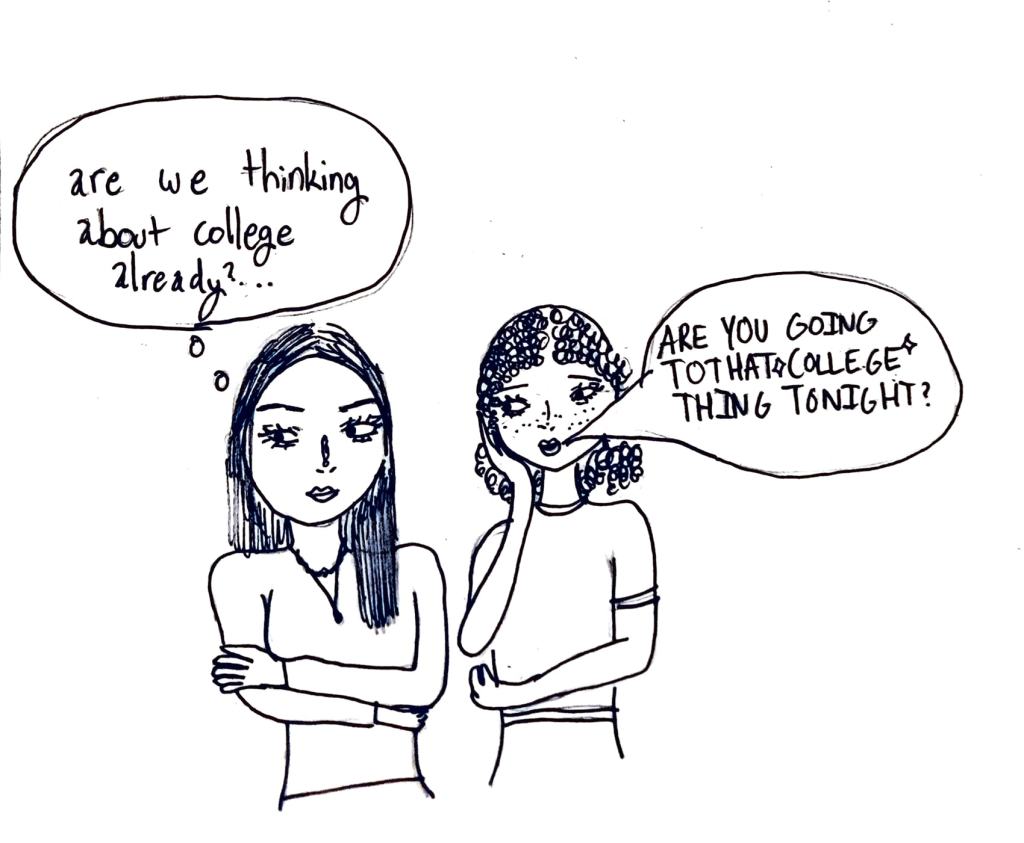
As questions of Where are you going to college? or What are you doing after high school? were thrown at Jahrie Houle (’26) in her freshman year, her heart started racing at the sheer reality that life after high school would be coming very, very soon.
Some underclassmen at Oyster River High School (ORHS) are looking to prepare for college ahead of time, instead of waiting until junior year. To do that, many have to look for those resources on their own, instead of relying on what they’re given in school. Searching for those resources brings out stress in some and puts others more at ease.
Houle agrees that she would feel less stressed as there would be some type of guidance to set her on the right path. She says, “I think that would make me less stressed because you know you’re on the right track, if anything. Like when people ask me, [in freshman year] what I wanted to do when I grew up, I was like, I don’t know. I don’t want to think about it for years. But it’s not even about what do you want to do, it’s more, how are you making sure you’re in a good space so that when you want opportunities you get them.”
Those opportunities inevitably come from resources from Houle’s point of view.
Deems Brant (’26) sees that having those resources can be helpful. He knows what’s out there as his parents’ professions deal with helping people with finding colleges. Brant states, “For my friends, whenever I talk to them, anything about college, they don’t really know anything about it at all. So, I feel like of our school could help them with that, especially with getting awards and stuff like that, outside of school that will help you with college. We don’t offer much of that.”
Not having those resources readily available at school forces those who want to learn more to search for outside resources.
Molly Schmidt (‘24) searched for outside resources and eventually came across a college counselor, who helped recommend schools for Schmidt to apply to. But even then, there was no definite bar on the application process.
She recalls that, “There was such a wide array, and it would kind of stress me out to hear people talking about applications that they already sent in. I wasn’t ready yet and my college counselor would say I was behind. But then I would be ahead of some of my peers, so it would be confusing to know where the bar was.”
Avery Martinson (‘25) has experienced how it feels to have a later start at getting those resources and opportunities. She says, “I would have come up with like a strategy of going through all the colleges, which ones I wanted to go to earlier. It’s really tricky to go back through that.”
Houle sees herself starting the searching process earlier than later. “I think it would be a little easier to start looking at it now because it doesn’t feel like it’s as big of an intimidating thing over you, if it’s introduced early on. But I don’t think for me personally it would be that different because either way I’m going to do a lot of my own research because I’m really passionate about my own education.”
She recognizes that the more someone knows about college and the searching process, the more in control someone can feel over their future.
Mason Gower (‘27) expected that he would find out more about college through school, even at the start of freshman year. He says, “I kind of did expect more people to talk about it, but I didn’t really expect much of those conversations. Probably because I feel that college shouldn’t be a decision to really talk about with teachers or parents. It should be made by you.”
Gower has also participated in programs such as Scoir that the counseling department recommended to find schools and what he wants to work as. Elise Bacon (’26) has done multiple of these tests and quizzes and finds that they rarely help plan out specifically what someone should do in the future.
Bacon states, “Right now the [counselors] really just like come in like once or twice a year. So far, they’ve come in and just been like, think about your future, take this personality quiz. But we all know we’re all constantly thinking about what happens after high school, whether we consciously or not. It’s because it’s this kind of blooming event that’s just getting closer and closer every day.”
Because many underclassmen are thinking of college and their life after high school do they feel more stressed? And would they feel more anxious if they got these college resources earlier?
Schmidt saw that it really depended on what type of student they were at the core level, regardless if they had an abundance of resources. She states, “A lot of people would just bang them out and have them done really quickly and really early. And then, even like a month ago, there’s still people who haven’t send anything and their friends were trying to get them to send their applications.”
Brant doesn’t feel like he would be more stressed, it would be the opposite. “I think having those resources would make it better, I’m going to have to apply for college anyways. Just knowing about it earlier isn’t going to cause me more stress. It’ll probably cause me less stress by my junior year.”
Bacon does feel stressed about what the future holds for her and how she would get opportunities to put herself in a better position. She both views it as something close and far away from now. “At the same time, like when I think about it, I have PSATs this year, SATs next year and college applications, it just feels so close. Sometimes it feels so, so close and other times…it feels like it’s years away.”
Molly Schmidt (‘24) remembers feeling like this when she first started thinking about college, not knowing what she wanted to do. As a word of advice, she says, “Don’t stress too much about what you want to do, because no one should be expected to know exactly what they want to do for the rest of their life. It will always change. So don’t feel like it’s the be all end all, just think about what you like, and try to go off on that.”
– Hannah Klarov


 Mouth of the River
Leave a Reply