
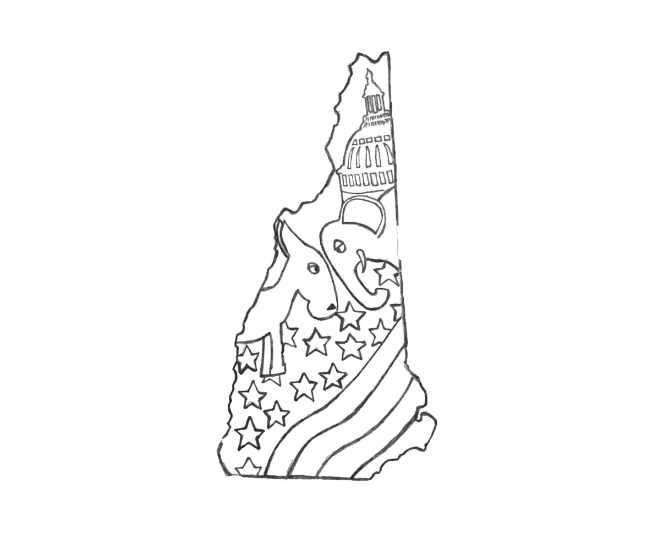
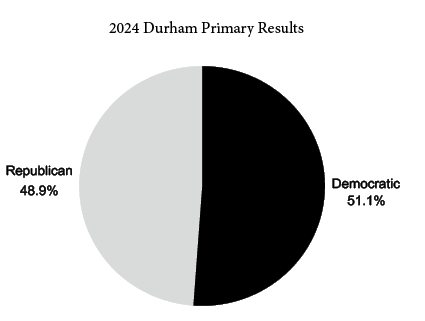
When it comes to politics in New Hampshire, we are an unusual state. In the recent 2024 primaries, thousands of Democratic voters switched their party affiliation to Republican or undeclared, an example of our independent beliefs. Durham residents vote within our high school’s gymnasium, our mailboxes are full of political flyers, and our national and local news won’t shut up about the election. Politics scream at you in New Hampshire. The volume of opinions is higher than it’s ever been. Are you conservative? Liberal? How does your zip code define your voice and vote?
I recently read A Different Perspective, a 2021 MOR article by Alden Swiesz. In his article, Swiesz highlights what it is like to be a conservative within Oyster River High School (ORHS), a liberal-leaning community. The influence of one opinion different than your own can feel isolating. Highschool is an environment that should celebrate new ideas and a variety of opinions, but it often amplifies the loudest voices. How as students are we supposed to develop our own ideas if we are only ever recycling a single one. I wanted to talk to New Hampshire high school students who lived in a variety of political demographics to get an idea of how different political viewpoints impact them. I started with our Route 4 rival.
If you were to drive 20 minutes away from 03824 to 03261, we go from blue to red. “There are conservative students who keep [Coe Brown Northwood Academy (CBNA)] feeling conservative,” said CBNA senior Ariella Price. After speaking with Price, I wondered how being surrounded by either a majority Democrat or Republican demographic within school would affect a student. At ORHS it’s common for a single opinion to circulate. But beneath the surface, there is a quiet conservatism that is often not announced.

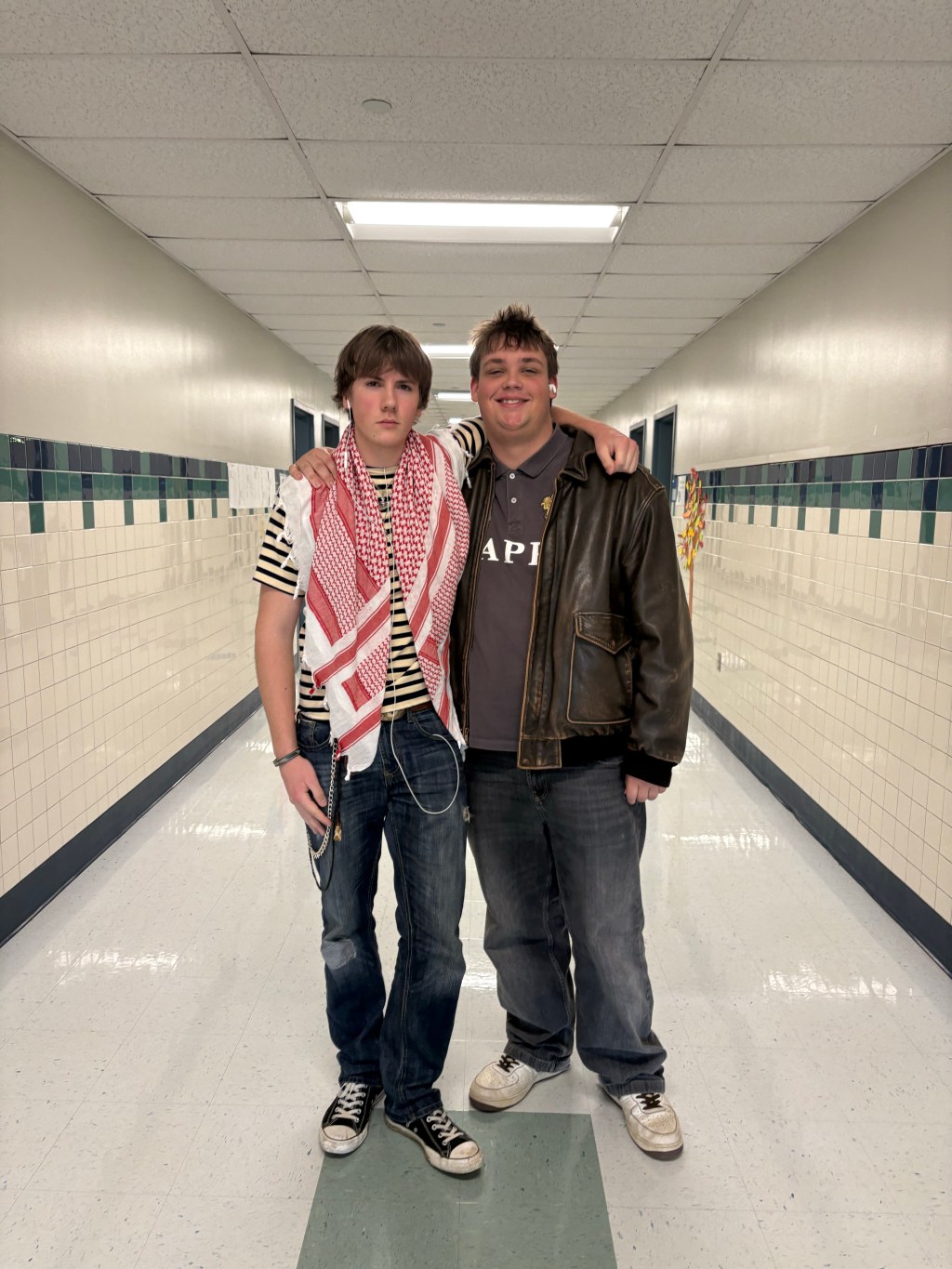
Harrison Burnham (‘25) at times holds his tongue with the understanding that opinions can be inflammatory. “In my citizenship education class there were a lot of students who were liberal leaning, and I was getting raved. You have to know when to deflect things and not care.”
This conversation would be reversed at Kingswood Regional Highschool (KRHS), just over an hour away in Wolfeboro, NH. Rheegan Swift (‘25) describes the school environment saying, “If you voted for Biden, you would stand out. Our school is a majority Republican and most highschoolers went to the Trump Rally held at our school.” Seven different towns feed into Kingswood Regional Highschool.
Looking at the distribution of votes in the recent election in Wolfeboro, there was a total of 2,275 Republican votes, 1,182 of those for Donald Trump. Only 664 votes were cast for Democratic candidates in Wolfeboro. The high school environment reflects much of where the area leaned politically. As a comparison, only 12 percent of the total votes in Durham went to Trump versus Wolfeboro’s 40 percent.
With areas that tend to vote one-way, students in the minority tend to feel restricted which is seen in both ORHS and KRHS. In towns that are split, it can leave politics at a standstill within high school. Dover is relatively split, reflected in the recent primary with 5,462 Republican ballots and 3,706 Democratic.
Colby Howard (‘24), a student at Dover High School said, “There’s a lot of pockets that exist. The political population varies, many different people with different opinions.” He also mentioned that because of this people tend to find and develop their own opinions. Howard continued saying, “My home life is different than what my opinions are. School allows me to rethink and find my own values as an individual.”
With diversity comes perspective. In a place where there tends to be a political consensus it can eliminate the formation of new ideas. For Burnham, he also differs from the beliefs of his parents. The difference at ORHS is he feels limited in sharing them. I wanted to understand, why do we lack this diversity of perspective?
In a research study titled, How ideological Migration Geographically Segregates Groups, from the 2014 Journal of Experimental Psychology, conducted a question based social experiment. Matt Motyl who has a PhD in behavioral sciences, manipulated people’s political standings by providing a questionnaire causing them to feel as though they were more liberal or conservative than they really are. The results of this study found that when people were living in a polarized environment, they are more likely to get up and move to an area with more likeminded people. This explains why towns and areas tend to lean one way which is reflected in schools.
As highschoolers, we’re trapped. We don’t have the ability to move if we feel surrounded by “enemies.” But what if, rather than see people with different ideas as enemies, we learned to value a diversity of opinions. If we keep talking to people who think exactly like us, we’re never going to get anywhere.
So, why does zip code define our vote? Because birds of a feather flock together.” Many of our political opinions are formed during these high school years. If we can learn to listen rather than argue we can begin to understand the perspectives of the people surrounding us. When we see people with different opinions as enemies, we divide ourselves slowly becoming a “Disunited States.”
– Maeve Hickok
 Mouth of the River
Leave a Reply