
Junior year is the year for college touring, and for Abby Trojan (’25), hours are spent in the car with her dad as they drive from the airport to a university. Alone in the car for a long period of time, Trojan’s father brings the conversation to the purpose of their travel: college.
This is a man who has known what he’s wanted to do since he was a young teenager working at his own father’s construction and real-estate company. He followed the straightforward path his father followed, and then married his wife, a teacher: another career with a straightforward path.
So, he is confused when his daughter tells him that she wants to go into archaeology and anthropology, which, at first thought, he only knows as “digging sh*t up.”
This is not an unfamiliar reaction to Trojan. Later on this college tour, she’s standing with other prospective students on the lawn of a campus, and the guide poses the classic ice- breaker question: “Where are you from? What’s your major?”
When Trojan tells them that she wants to major in archaeology, she gets a pause.
And then: “Oh, like Indiana Jones!”
Trojan replies “Mm, little less Holy Grail with Nazis…more like, lab coat.”
Trojan knows she would not get this same reaction if she were to be a business major, or a teacher like her mom, or in construction like her dad. Most people, like her dad, can’t fathom this as a career. But Trojan knows her path: a four-year degree, a graduate degree, picking one of hundreds of subfields in archaeology while pursuing her Ph.D.,
But for Trojan to follow this more niche path, she’s aware that she needs to make sure that this is what she wants to do before she devotes large amounts of money and time to pursue it. The University of New Hampshire (UNH) Challenging Academically Talented Students (CATS) program, a non-degree program through UNH that allows high school students to take one free UNH class per year for credit, allows her to do this.
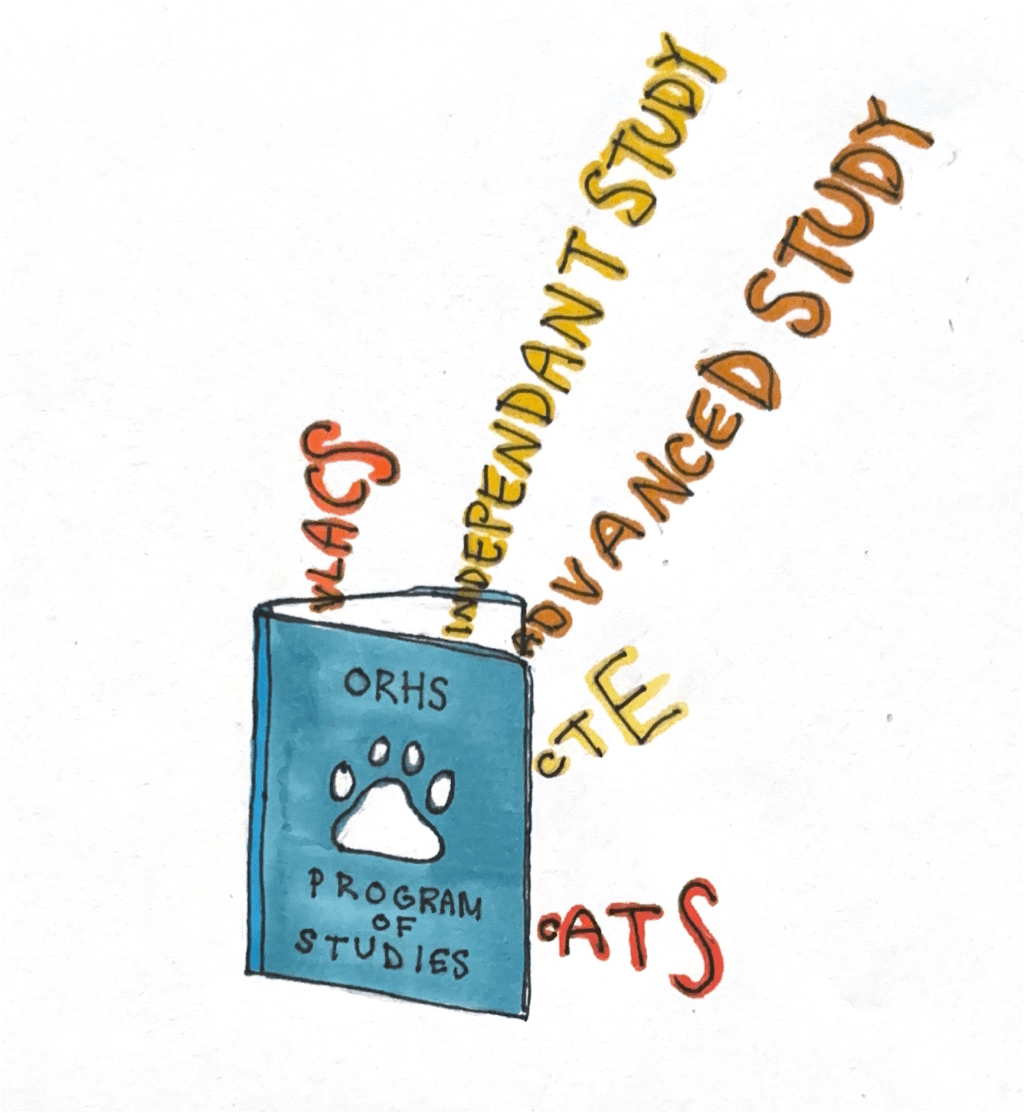
The CATS program is one of many options for Oyster River High School (ORHS) students to pursue academics outside of the ORHS Program of Studies. There’s also VLACS, the virtual learning platform, Career and Technical Education (CTE) through the Dover and Somersworth high schools, and any learning activities categorized as an ELO, or Extended Learning Opportunity.
Allowing students to explore these options is important in many ways, one of which being saving time and money later in life. “It gives students a change to dive deeper into something they’re passionate about…they either become more passionate or figure out ‘this is not for me’,” says Sean Peschel, the ORHS ELO Coordinator.
For Trojan, she became even more passionate about archaeology, and she’s grateful she figured this out before she entered college. “I was really nervous that I was going to start college, plan out that I’m going to do archeology and anthropology, but it turns out that I’ll hate it,” she said. “I’d have spent all this money, all this time researching this perfect program, and it’s all for nothing,” Luckily, taking her CATS class cemented her passion for archaeology, and her path in it, when she enters college.
For Madalyn Now (‘25), her health science class through the Career Technical Education program at Dover High School also helps her save time and money. Now says, “You get to see if it’s something you’re interested in. There’s definitely some kids who are now having second thoughts, like ‘I don’t hate it, but it’s not something I want to do now.’” For herself personally, Now says, “I’m a very indecisive person, so picking a major in college is going to be very difficult for me to commit to something, but this showed me that this is where I want to go.”
These outside learning opportunities also grant students the freedom to have a taste of life after high school. Trojan enjoys the preview of the college environment she gets before she’s even in college. “I love the college environment so much because everyone’s just there to learn and have fun,” says Trojan.
Anika Pant (’25), who attended a multivariable calculus class through the CATS program, feels the same way. “Because it’s university-style, you have so much more freedom about your own education,” says Pant.
Unlike Trojan’s class, which consists of lectures two days a week, Pant’s was a weekly commitment: three days of lecture two days of recitation, in which she took quizzes and the TA went over the homework. She would go with a few seniors from ORHS in a carpool, and she thoroughly enjoyed her class, especially the freedom it granted.
“You’re able to take control of your own education—you know what’s important [to you] about it,” says Pant. If she didn’t have the option to take classes outside ORHS’s curriculum, she would have surpassed all the high school’s math classes by sophomore year.
Courtney Giroux (‘24), who’s taking an advanced study in linguistics, says “[My Advanced Study] is a thorough learning experience because I’m more engaged in the topic.”
These concepts of freedom and changing things up are prevalent in many of these outside learning opportunities because students have the freedom to create a learning experience that’s tailored to themselves.
Through the ELO programs, they have a wide range of learning experiences to create for themselves.
“We have five different categories of ELOs at Oyster River: independent coursework, which is designing a course or experience that we don’t currently offer in the building…, advanced Studies…building upon things we already have in the building…, internships, which are work-based learning experiences…., peer instructor, and while it’s not credit bearing, also career exploration,” says Peschel.
One of these types of ELOs, Advanced Study, allows students to create a continuation of a class currently offered at ORHS. For example, if a student has completed both Acting1 and 2, they could create an Acting 3. Or, if they completed Marine Biology, they could design a Marine Biology 2. The advanced study route is one that Giroux decided to pursue.
In the last few weeks of her linguistics class, Giroux wants nothing more than to continue the course. She loves everything about it—her teacher, her classmates who are uncharacteristically willing to engage in in-depth conversations about topics within linguistics, and of course the subject in general.
She thinks, if there were to be a second linguistics class at the school, she’d be in academic heaven.
“Linguistics 2! Linguistics 2!” Giroux chants at her friends in the comforting atmosphere of Shawn Kelly, ORHS English teacher’s room.
But no one else seems to be on board.
So, Giroux’s next best option to continue learning about linguistics was creating an Advanced Study ELO on linguistics, with the help of Kelly and Sean Peschel, the ELO coordinator.
Giroux customized her ELO to continue to study topics of language and thought, phonemes, and language acquisition. Customization is one of the many important components of ELOS. “[ELOs} are not only individualized, personalized, and customizable, but they also have exposure, exploration, and experience,” says Peschel.
Giroux has weekly meetings with Kelly to show him what she’s done towards her ELO: presentations, mini-tests, research, and more. “I run it like a mini class where I’m the only student,” says Giroux.
Pant also had a class of one her sophomore year. She created an independent study in which she took AP Calculus BC on her own, using the same resources that the actual class is provided with.
Classes based on current ones offered at ORHS aren’t the only type of independent studies, though. Trojan is also pursuing an independent study alongside her CATS class, but it’s one that’s much more out-of-the-box.
She’s building up the Women in STEAM and DEIJ clubs as part of her ELO. “I am interviewing people, creating events, reaching out to people, emailing, and all that, I’m basically learning communication and business management skills,” says Trojan.
These “classes of one” are helpful for students who have no other option to learn the specific thing they’d like to learn. However, sometimes the class one wants to pursue exists, just at a different school. For those who have more technical or medical passions, high schools in towns such as Dover and Somersworth provide those classes for students in their surrounding areas, through the Career Technical Education (CTE) program.
Now is currently taking a health science course at Dover High school, which prepares her to become a licensed nursing assistant (LNA), and she loves it.
Every day, after being bussed over to DHS, Now walks into a room that’s about half Oyster River students, half Dover students, and a sprinkling of students from other schools. While of course the class is still a class (complete with quizzes, workbooks, etc.), there’s also plenty of unconventional activities in Now’s health science class. She’s done things from taking classmates’ vital signs to spending 60 clinical hours working in nursing homes.
Of course, there’s less-pleasant times. For instance, Now remembers a day where one resident projectile vomited everywhere in the dining room, and as soon as the students began to clean it up, two more residents did the same! But Now doesn’t mind these moments, because the bonds with residents and the satisfaction she gains from helping these people are completely worth it. “You can see that they need it, and some of them you can tell appreciate it,” says Now.
The meaning and experiences Now gained from her CTE classes are just a few of the benefits she gained from the course. Now was also exposed to networking connections through her CTE class, such as internships and jobs that are pretty much guaranteed to her once she’s licensed as an LNA when her health science class ends.
It’s not just CTE classes that expand students’ opportunities available to them, though. Trojan has begun doing independent coursework with her professor and was introduced to careers in archaeology through UNH’s anthropology and archaeology fair. She’s now interning under her professor at the Strawberry Banke Museum in Portsmouth, and is learning, in real time, the methods of digging, researching and restoration components of archaeology
These sorts of opportunities, along with the meaning, exploration, and enjoyment students get from academics outside the ORHS Program of Studies, are crucial for students to be provided with. It allows them to become engaged in the world, because they love what they do. “The true outcome of school should be creating better, engaged citizens of the world,” says Peschel.
– Paige Stehle
 Mouth of the River
Leave a Reply