
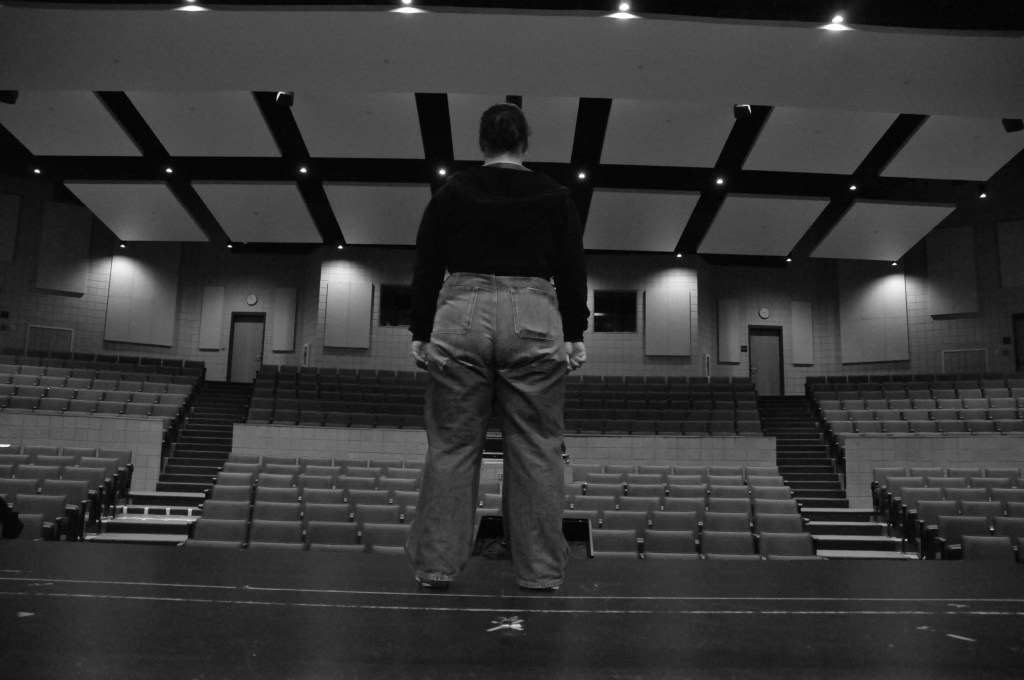
The auditorium doors are locked, and nervous energy permeates the air as students gather in the hallway. Despite the nerves, there’s an undertone of excitement when a line starts to form. Names begin to fill the sign-up sheets taped to the wall for this year’s Fall Play auditions.
Everyone has a different strategy to prepare for an audition. Some sit quietly and read their monologue to themselves. Some don’t even look at their materials and stare at their phone or into space. Sometimes shouting fills the hallway as someone practices their monologue for a friend to judge. The hallway quiets as Alex Eustace, Oyster River High School (ORHS) English and Acting teacher, and director of the Fall Play, walks down the hallway, and unlocks the auditorium doors. Auditions have begun.
Every year, ORHS announces their annual Fall Play production: a non-musical theatric performance. Everyone sees the final product—but not everyone knows how it feels to put everything you have into a mini performance for three people just to earn a spot on that stage.
This year’s production is the 39 Steps. In ORHS’s production, one actor plays the male lead, another plays all three female leads, two play “clowns” who represent over 100 supporting characters, and six actors play other supporting roles. Unlike plays in elementary and middle school, not everyone who auditions gets to be a part of the production—it’s selective, just like tryouts for sports.
For auditions, everyone must perform a comedic monologue. Clara Thorn (’25), one of 17 auditioning students, prepared her own. “I wanted a monologue that showed off sassiness and emotion, and a little bit of insanity,” she says.
Thorn’s preparation for the audition this year consisted of reading the monologue through at least twice every day after school and preparing with hydration and vocal warm-ups 24 hours in advance. However, Thorn hasn’t always been as composed and prepared. In the past, being onstage has been pure anxiety for her: hands shaking and cringing at every mistake she made. However, Thorn, with more auditioning and performance experience now, says, “I knew what I was getting into, I knew what was expected of me…so I actually had a lot of fun with it.”
Unlike Thorn, Levi Brandt (‘25) has never auditioned for a performance before. “I finally went out of my way to go watch a play or two here at the school, and I was very jealous of everyone because they were all really talented and I wanted to be a part of it. So, I went ‘why don’t I just give it what I got and see what comes of it’,” he says.
In the brightness of the hallway, the directors hand Brandt two monologues, one for female roles, one for male roles. Brandt studies the papers and decides on the female monologue. It’s his first audition—he may as well go all out, right?

Brandt walks into the darkness of the auditorium, and as he walks onstage, decides to put everything he has into his performance: he flails around and screams just as the monologue calls for. He finishes, and the directors’ faces are unreadable. Then, they ask him to repeat the monologue–this time in a British accent. Once the performance is complete, he takes his first deep breath in what feels like hours. He knows that he’s done well.
“I way overdid it, which is what they want… they want you to flail around and scream and really oversell it, because that’s what comes across [well] onstage,” says Brandt.
Of course, what often comes with a great performance is an underlying layer of nerves and anxiety. Thorn has felt it, Brandt experienced for the first time the nerve-wracking experience of auditioning, and Odin Whiteley (’25) definitely feels the nerves that come hand-in-hand with auditioning. However, he channels those feelings into his performance: “I try to direct those fearful emotions into what I’m saying,” he says.
During his audition, as Whiteley looks out into the nearly empty auditorium, he feels like he wants to just say all his lines and get out of there as quickly as possible. But he has a performance to make. He reminds himself of the tone of the monologue Eustace gave him: it’s a rant, it’s angry, and it shouldn’t be too funny. Despite the nerves, despite his desire to run out of the auditorium, he puts on his performance.
“I find that the better auditions, and the more entertaining ones, are the ones who feel comfortable on the stage,” says Thorn. But having visible nerves onstage isn’t an end-all-be all.
“I try not to ever discredit anyone for being nervous, because I know the first few times I auditioned in high school, I was very shaky and panicky [makes an un-transcribable shaky and panicky noise],” says Eustace. He too was once just another panicked teenager on that auditorium stage.
Eustace’s freshman year was his first ever audition for the spring musical. With all the confidence in the world, he waltzes onto that stage in typical Eustace fashion, thinking, “Yeah, I’m going to nail it; I’m just going to be automatically good at singing and dancing and acting and everything!”
He auditions, and we will never know what went on behind those auditorium doors that early spring of 2010. We do know one thing though: the audition did not go the way Eustace imagined.
“I was so confident in myself, and I did a terrible job,” says Eustace. Sometimes, you can do the best you can, and it simply doesn’t fit what the director’s looking for. However, sometimes you do fit what the director’s looking for, and you get callbacks.
“Callbacks don’t mean you do or don’t get a part, really—the real point of callbacks is to measure chemistry between people,” says Eustace. This “second round” of auditions has actors receiving small portions of scripts (scenes) day-of and acting them out with other actors.
Two actors compete for the main male role of Richard Hannay during callbacks, Brandt being one of them. This is in stark comparison to the nine or so actors competing for the lead female role and “clowns.” “Only me and Odin got the callback for the role of Hannay, so we had to do every scene over and over again because…there was a ton of people [auditioning for the other roles],” says Brandt.
Callbacks are somehow less scary than the first round of auditions because you’re not alone, and simultaneously scarier, because everyone is watching you. “A lot of really talented people [were there]… I felt a little bit like I was in over my head,” says Brandt.
Even with all the emotions students face while auditioning for the fall play, Eustace says, “I think everyone should [audition] at some point. It’s such a fun experience to do a show, but I think if you have the right attitude, it could be fun just to audition for a show. We get people every year who audition just to audition.”
Come see the 39 Steps on November 21-23. Brandt, Thorn, Whiteley, and the rest of the cast look forward to seeing you.
-Paige Stehle
Cover photo courtesy of Ian Hilfiker



 Mouth of the River
Leave a Reply