
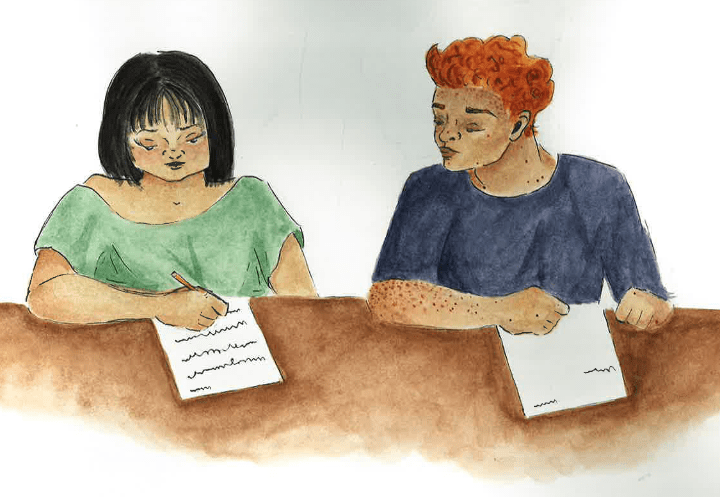
Sitting in the library on a quiet Monday morning in early December, I waited to interview Assistant Superintendent Suzanne Filippone about Oyster River’s cheating culture. My palms were sweating and my mind was racing a million miles a minute. I wasn’t sure how she was going to react to the information I was about to share. I didn’t expect the reaction I ended up getting, not because I didn’t think she would care, but because you would never quite expect to see that level of emotion from an administrator during the day.
Our conversation broke my heart bit by bit. It was difficult to see Filippone’s reactions. She grew emotional as I asked her questions and explained to her the scope of the “cheating culture” at ORHS. Even though I was doing the interview, she had questions for me. “What are those pressures and those expectations on you or that you’re putting on yourself?” she asked. She wanted to know, “[what is it that makes] the cost worth it?” Her raw shock spoke volumes.
In the seven months I’ve been attempting to answer the very questions Filippone asked that day, I have learned so much. There isn’t a student at ORHS who goes through their high school career without some level of awareness of the cheating that goes on here. However, these seven months have taught me the true scale and, perhaps more importantly, I’ve discovered how unaware many of the adults in the building are about what’s really happening—to the extent where one anonymous student said that, “teachers just don’t notice, or they really don’t care.”
How often is cheating happening at ORHS? “There’s always an argument to say that there’s only a couple of kids [cheating] and so the solution just needs to be targeted to those couple kids. But, in all three grades, I’ve seen cheating in every single one of those classes I’ve been in by all types of students,” an anonymous student, M, shared. He went on to list how he has seen cheating, “[ranging] from using previous years’ test answers, to stealing tests from teachers’ desks, to stealing midterms from teachers, to selling complete course curriculums of every single test from that year for money.”
M also highlighted an example of how students take advantage of their teachers’ mistakes, including “the majority of a class using a released test that the teacher released by accident,” and none of them thought to alert the teacher that this had happened. “We all just wanted to get the good grade.”
Through all of my conversations with students, I heard the same things countless times as examples of what cheating looks like at Oyster River, and I was constantly reminded that, here, cheating is not limited to copying the occasional Spanish homework—a measly formative grade—even though that’s the type of thing that happens most often.
Walking through the halls, surrounded by the echo of students asking one another “did you do the homework?” or “can I have the answers to last night’s assignment?” Answers to these questions range from “I was hoping you had them” to “they aren’t right, but you can have them.” To which students often respond, “they don’t need to be right. It just needs to look like I tried.”
A scene all too familiar to ORHS students. It begins with the simple request to copy one’s homework, morphs into the constant questions of how you did on a test, what grade you got on a project, what your GPA is, etc. From there, many students find themselves engulfed in this culture.
When an anonymous student, C, was asked if she had ever cheated academically, she responded, “oh 100%!” I asked immediately what her preferred method of cheating was, hoping it would give me some insight into what type of things she’d cheated on, to which she responded, “just having paper with me that’s under my test or something.”
Students might begin by cheating on homework because they’re stressed, or because it’s easy and they feel like they can, which then can lead to higher stakes cheating when students feel they don’t know the material or are pressured to achieve a certain grade. And the cycle only continues.
What types of students are cheating at ORHS?
Many think of “cheaters” as those who don’t care about school or are too lazy to put in the work but that’s not always the case. Here, as in any school, there are students who fit that stereotypical perception but here there’s also the students who care so much about their grades and being successful.
When asked why she thinks people cheat, ORHS Principal Rebecca Noe said, simply, “Nerves. Fear. Pressure.” She paused, and I could see her thinking before she continued, “I think honestly, pressure.”
Noe reflected on her experiences as both a teacher and an administrator dealing with and investigating instances of cheating. She explains that, “the stereotype is that it’s going to be a certain type of student or kid, and a lot of times it’s actually the people who have A-pluses or are on the honor role.” She went on to say that oftentimes for these students it happens because of the academic pressure they’re under.
This issue stems from a variety of factors but is largely fueled by the culture of ORHS. At Oyster River, there are types of cheating that many students wouldn’t even qualify as cheating. Asking what material was on a test or for the homework answers, while technically cheating, is something that happens constantly here. Students add fuel to the fire as they warp the definitions of cheating in order to excuse these behaviors, and other students succumb to the pressure of their peers, making it into a culture.
Throughout my reporting, a sentiment that was repeated by both students and the occasional faculty member was the idea that they wouldn’t be surprised if cheating was happening in some capacity on almost every assignment in the building.
How do we, at ORHS, define cheating?
Cheating as a concept has a vast realm of applications and meanings. To effectively understand that, I figured the best place to start would be the Oyster River High School Student Handbook. The handbook begins the Academic Integrity section by stating, “In support of Oyster River High School’s mission to become a community of educated, ethical, and responsible citizens, this section outlines the standards for academic integrity to which we hold ourselves.” This section of the handbook is broken into two parts: Plagiarism, and AI Writing Generators. The handbook emphasizes the importance of students doing their own work and ensuring they give credit to the work of others.
The section of the handbook was understandable, but it was also so vague and unspecific that it left me unsatisfied. So, I asked every single source I spoke to how they defined cheating. I was overwhelmed with a variety of definitions ranging from simply breaking the rules or getting answers ahead of time, to the more expansive definition coming from anonymous student, B, “giving yourself an advantage that isn’t readily available.”
Faculty also shared a range of definitions including math teacher Peter Harwood’s, “unauthorized aid.” Filippone initially bounced around the word “dishonesty” before settling on the definition of “claiming something [as] yours that is not yours.” Filippone went on to highlight why cheating is wrong saying, “when you cheat, you cheat yourself, and [most] people will feel like they’re wronging themselves. I think that most people know and understand when they’re cheating, they’re doing something they shouldn’t be doing, and I think that that can have a negative impact on the individual or the person.”
Regardless of how students define cheating, it’s obvious to students that cheating happens all the time on regular class assignments and tests. However, sometimes the cheating is crystal clear. Through my conversations with sources, I discovered how far it spreads beyond just those class assignments to cheating on national exams.
At ORHS cheating has become normal, and there are students who rely on that sense of normality and continue cheating on their AP tests. They change their seats, have their phones with them, and work with their peers in order to get the best score by any means necessary. Anonymous student L reflected on their AP test cheating experience saying, “I’d cheat a million times to avoid taking that class in college.”
How did we get here? Why is this an issue? How does the community play into this?
We are surrounded by higher education. UNH is in our back[1]yard, and many families have some relation to higher education, either having attended college, teaching/working in the education field, or simply understanding the importance of education and wanting the best for their children. With that, there’s a sense of pressure on Oyster River as a district to educate students in the best possible ways and to help students be as successful as possible through receiving high grades, getting into esteemed colleges and universities, and going on to good jobs. That pressure creates a certain expectation for students to perform and be “successful.”
These pressures and expectations have drastic impacts on students making them feel as though the most important thing is the grade and takes the importance away from learning as a whole concept.
Student W reflected on the scope of cheating saying, “I know people getting into really good schools that have cheated their entire way through.”
Student M shared a detail that perfectly follows W’s thoughts, saying, “I personally know someone who got a spot for the same exact major, college, and scholarship that two qualified people applied for, and the cheater got the spot.”
W continued her earlier thought saying, “Why wouldn’t you cheat at Oyster River if you’re not going to be punished for it but rather move ahead in life?”
M’s and W’s thoughts here tie to the exact reasons why a cheating culture is so dangerous. When cheaters aren’t punished, the non-cheaters end up feeling the brunt of the toxicity of this culture.
I have tried to remain objective in my reporting of this story, however I know this toxic feeling all too well. Last year, I was in a class where I later found out that a large portion of the class had been consistently cheating on tests and earning near-perfect grades. This was an extremely frustrating thing to find out for multiple reasons. I’d put in so much work trying to learn and understand the content while many of my classmates were just cheating their way through. I understand the pressures these students were feeling that pushed them to cheat but I was dealing with those same pressures and didn’t go down that path. Seeing my peers repeat these habits daily became increasingly frustrating as time wore on.
What type of students are affected by this cheating culture?
At ORHS cheating seems to be coming from many “smart” students who are expected to perform well and get good grades.
“It’s all high-level classes, these are all AP classes, the students who are doing this are in the top-10 of Oyster River every year,” M claims.
Student W gives insight into the rationale from a “high performing” student. “The way I think about it is the college that I’m going to, and what I want to work towards, doesn’t have to do with any of the classes that I would be cheating in, and that’s how I’ve justified it. But also, it’s honestly just really true.” W acknowledged the lack of popularity among faculty for this opinion continuing, “When will I ever need these things in my life ever?”
This leads to a deeper question: What parts of our culture promote these behaviors?
An anonymous student, X, thinks it’s bigger than just Oyster River. “[That’s the] culture of the world and academics right now.” He continued by speaking about the perception of how much harder it is to get into college and the idea of grade inflation, and the pressures that these things put on students.
Most of the students I spoke with highlighted that what has led them, or their peers, to cheat is that they are experiencing this intense pressure to be successful, and the emphasis is on that rather than the importance of learning the material.
ORHS Writing Center Coordinator, Jake Baver, was able to provide a unique perspective given that he attended Oyster River High School and has seen the pressures put on students and continues to see those pressures in his current position. Baver highlighted the idea that ORHS has “always had a reputation for being the public high school in New Hampshire that churned out top level graduates that would then go on to do excellent things in college and beyond.” Baver continued by saying that he thinks “that’s a dangerous reputation to try to uphold because it emphasizes excellence at the expense of the general population’s wellbeing at times.”
Oyster River High School, according to US News and World Reports, is currently ranked as the 5th best high school in New Hampshire. “We used to rank better nationally,” according to Baver, which plays into the pressures put on ORHS students to perform.
In a Newsweek Top School ranking from 2013, Oyster River High School was ranked 753rd in the country and second for New Hampshire. A Foster’s Daily Democrat article from the time quoted Amanda Martin, who spoke about the effect that teachers had on ORHS receiving this ranking, saying “I think they push us because they see your potential.”
Former Principal Todd Allen reflected on the school’s ranking in the same article saying, “our kids definitely come through here and graduate with a plan. I think that’s largely what’s demonstrated through the ranking.”
While the ranking itself may not be a driving factor, it plays into the expectations of what Oyster River stands for and what students are supposed to accomplish. This plan that Allen talks about begs the question: who comes up with these plans? Oftentimes the plans are curated by parents and families, not by the individual students, and that’s a large portion of the problem. Students need to be able to come up with what they want to do with their lives and how they want to use their education. By preventing students from doing this for themselves they begin to do anything in order to meet the expectations put on them, even if that means cheating.
So, what is the next step?
I’ve been working on this story since mid-November of 2023, and when I started writing I knew that cheating was happening but not quite how to feel about it. Before thinking of this as an article I was frustrated with the kids who were cheating because it felt like the hard work that I’d been putting in was being invalidated. I then went through a phase of being so overprotective of the students because they were under all of these external pressures. It wasn’t until my final conversations about the story with Mr. Kelly that I realized the truth. The students aren’t victims or villains. Yes, they’ve done something wrong by cheating but the point of this story isn’t to punish them. The goal is to begin a conversation about our cheating culture.
Faculty doesn’t understand the extent to which this is happening, students don’t feel like they’re doing anything wrong because they’re all doing it, and outside of the building people don’t see what’s going on. So, the first step in creating a solution is having a clear path of communication between students, faculty, and families. We need to feel comfortable talking about the pressures students experience, and the expectations of the people around them.
However, there isn’t just one solution. We need to reduce the emphasis placed on receiving high grades by fully committing to competency-based grading. We also need to change the competitive mindset around academics by ending the conversations around how we did on a given assignment. Additionally, we need to be better at catching cheating when it happens and ensuring that there are clear and consistent consequences. If we all take on these things collectively, we can begin to change this culture.
-Delaney Nadeau
Image courtesy of Kate Stone

 Mouth of the River
Leave a Reply