

As the bell rang, signaling the end of the school day, seventeen-year-old Megan Thompson quickly ran out of the doors of her small K-12 school and jumped into her car. With excitement traveling in her veins, she drove up to the Pats Peak Ski Area, the ski resort that she had been teaching at since she was thirteen.
Although working at thirteen probably violates a lot of child labor laws today, Thompson thought of her part-time job as anything but labor.
“I started with a kids program and learned how to teach very small kids, hung out with [them] all weekend long, pushed them down the mountain. Then they hired me as a ski instructor, and I started teaching in an after-school program. You no longer can work when you’re thirteen…at thirteen, they would pay me cookies.”
Thompson still instructs at the mountain and the community is still strong. Most of the people that started instructing there when she was in school have never left.
Back in her school, Thompson’s graduating class was also well known for having a strong community and personality. In her senior year English class, Thompson and her fifteen other classmates didn’t want to just learn the curriculum anymore. They wanted to try something else.
“We did a whole school spirit play about the school and our uniforms. We went crazy with it. So, we put the name of our school on our glasses, pants, and everywhere. We made a parody of some of the extremes and of our teachers in the play. That was my class…we were just unapologetically us, and we did it with tons of personality.”
Her advice to today’s high school students is to pursue the high school experience that they want. Instead of just talking or dreaming about it, make plans and go for it, because it flies by fast.
Thompson remembers being proactive in her grade, especially when she became a senior. For example, she wanted a senior video and trip for her class, and they had one because she brought up the idea and went for it. She states, “I just did it because these are experiences that I wanted. Find the people and find the resources.”
Surrounded by a dozen other students in a small, cozy cafe in the downtown area near her high school, Marjke Yatsevitch was focused on deciphering what the painting above her, by Mexican painter Diego Rivera, could possibly mean. Her peers around her were doing the same, as that was this week’s topic of the club she created: the IF Club.
She explains, “I started a club called the IF Club, which stood for intellectually frustrated, and we basically used it as an excuse to play around with ideas that we didn’t think got enough attention.”
There were no assignments or lectures, they just spontaneously learned about whatever they felt like, driven only by their curiosity. Whether it was Italian art films or the Harlem Renaissance, they delved into the topics through conversation over a cup of coffee.
Along with extracurriculars, Yatsevitch was also a big fan of school spirit events. Almost everyone in her school was. Different from school spirit today as a whole, it wasn’t just focused on the athletics portion of school spirit nor the competitiveness of it either.
Yatsevitch also remembers that there would also be a focus on the arts and culture. “We would have student bands on the floor of the gym and the sports teams coming in in full costumes on tricycles, while my friends would all be playing the bass and guitars and drums, and we would all just come down off of the bleachers and dance in the middle of the gym floor.”
Her grade was tight knit, and this famously came through on her graduation day.
She remembers her class president and valedictorian giving their speeches. At the end of those speeches, everyone split into parts of a choir and sang along with the band that was performing there.
Yatsevitch recognizes that if she wasn’t open to meeting people that were outside of her group, she wouldn’t have the experience she had. Although in high school there is always some element of wanting to conform, she assures students that it won’t matter much in the long run.
Her advice to high school students today is, “Have an open heart over being concerned of what other people think of you…focus on the community around you and celebrate it.”
Oliver Philbrick was sitting in study hall, doodling in his English notebook, when suddenly one of his friends — who was standing outside of the hallway with the door ajar — motioned to him. As Philbrick walked out, his friend shared the latest project he was working on: a video called Rate my Locker. He needed Philbrick’s help.
Rate my Locker was one of the many creative projects that he took part in during that time. “We shot videos for one of my friend’s video projects called Rate My Locker and he went to a couple of friends lockers and rated what was in there…I watched the video back, kind of like a year ago and I was struck by the freedom of movement we had at that time.”
This remains one of his fondest memories of high school and it was a time where he could freely be creative and spontaneous.
Although Philbrick graduated in 2018, he recognizes that this probably wouldn’t be able to happen so easily today. “A part of that is the new culture; security in schools, really controlling who’s entering, who’s leaving in hall or being in the cafeteria…it feels a little more constricted than I remember.”
A lesson that he learned through high school that he took to his adult life, is remaining passionate about his hobbies and interests, and not being embarrassed of them.
“When I was a kid, the nerd culture wasn’t quite as prevalent as it is now. But Mr. Garman was particularly open about his love for nerd culture. Seeing that as a kid was really important, just seeing that you don’t have to hide your interests.” Not hiding his interests and who he was, helped Philbrick find the people that he’s still close with to this day.
Philbrick’s advice for students today is to take risks socially. “Get out there and get to know people. I’m still really good friends with a lot of the people I met in high school. Every year now we host a music festival in the summer, for just friends of mine, people we know. I appreciate that I get to be part of that community.”

8 year old Fleming and President George Bush Sr. in 1989
Causing laughter that could be heard down the halls, Colleen Fleming, who was voted Class Clown at graduation, sat in her last class of the day. As the bell rang, she said her goodbyes to friends and walked out the school doors. She began switching gears to another side of her as she made her way to work as a secretary for the Secret Service.
She didn’t quite realize how lucky she was to be able to take that job when she was in high school.
“I guess kids in general don’t get calls from the President of the United States,” she said with a smile. “I was 17 and 18, so I didn’t appreciate it.”
As she recalled what the job entailed, she said that she would support the Secret Service agents that came in and help them prepare reports. This meant she had top secret clearance and even had access to the President’s itinerary. She went to a few White House Christmas Parties and was able to see the world’s politicians in person. That job in high school eventually led to her job as a federal agent, which she kept for 25 years, before coming to work at ORHS as a retirement job in 2022.
Before she got the job with the Secret Service, she was a three-season athlete, running indoor and outdoor track, as well as playing field hockey, which was her favorite. Playing as an aggressive half-back on the team, she earned herself the nickname, Animal.
In school, she admits that she was quite the class distraction, always having something sarcastic or funny to say that would derail the whole lesson.
She says, “I was someone who was kind of upset when I graduated because I never really enjoyed the school part, but I enjoyed the socialization part… [Now I think], ‘how I wasted my days in school! I could have learned so much more!’ ”
Fleming says that because of the opportunities she’s been given between going to college and her agent experience, she always tells her kids to “get an education because it’s something no one can ever take away from you and you’re always going to have it as backup.”

Wainwright’s senior photo
In the back of the chemistry class sat Jennifer Wainwright hoping more than anything that she wouldn’t be called on. She was terrified of even the thought of speaking up in class, much less in a class she didn’t quite enjoy. She thought chemistry was particularly boring and would have rather been in a class that would contribute to her becoming a marine biologist someday, or a class she found simple enjoyment in, like a math class. She would have even wished to be at the pharmacy, working her shift which wasn’t exactly her favorite either.
When Wainwright was in high school, she liked her math and science classes the best. She was a quiet student who wanted to talk in class as little as possible, but still took it seriously. She took upper-level classes and was on honor roll all throughout her high school career.
She not only worked hard in her classes, but also in her extracurriculars outside of school. She was a member of the National Honors Society and was on the math team, which she loved. She tutored her peers in math during school, and even got paid to tutor outside of school.
On top of that she had a job at a pharmacy near school, which later in life helped her to figure out that she didn’t want a customer service job, or a monotonous job like working in a lab. That eventually lead to her decision to become a chemistry teacher, after she began to find her love of the subject in college when she had a great professor in her college chemistry class.
When she wasn’t doing homework, extracurriculars or her job, she remembers how she used to go to the mall with friends, something that she wishes was still common. She says they also loved to go to the beach, the movies and to football games on Friday nights. She has fond memories of doing “fire drills” with her friends at stop lights, where everybody would jump out of the car, run all the way around and get back into another person’s seat. She still bumps into some of her high school friends in town and smiles while recalling years of Christmas cards received from them.
Her advice for high schoolers of today, is to “have your dreams of what you want to do, but just know that reality might hit, and you might go, ‘I don’t want to do that,’ or ‘maybe I want to do this first!’ It’s ok to not end up doing what you dreamed of doing.”

Young Fan in college
Trudging home after a 12-hour day of classes with heavy bags full of textbooks, and the weight of society’s expectations to do well on her back, an exhausted Lisa Fan made her way home. After a week full of days like these, class all day and being tutored at night, she was more than ready to have a weekend of relaxation. But exams were coming up, and she was expected to be up bright and early the next morning to head to the library and work on her homework packets with her friends.
Fan says that the school system in China was much different than it is here. She says that the classes are as large as 60 people, and rather than having the students switch classrooms, they stay in their home rooms with the teachers switching every period.
“Chinese school is one way teaching. I get it because we had a big class group, and the teachers just wanted to feed you all the knowledge and prepare you for the exam because the system is more exam oriented. We didn’t really have time to ask questions. We would just take notes, memorize things, and go to exams.”
Studying was her whole life, and it was the same for everyone at her school. Even classes other than core classes were called a waste of time. Before exams all physical education and art classes would switch to core classes to help the students review. Rather than playing a sport or doing a club after school, students were expected to go to tutoring or night classes if they wanted to do well.
Even though the experience was incredibly difficult, Fan says, “What I appreciated for my education experiences in China was it built a strong foundation (especially in math) and fostered resilience in me. There is a saying in Chinese, ‘You will only taste the happiness/sweetness in life after going through all the hardship/bitterness.’”
Today, Fan tells her students that her goal is not to prepare them to get all As, it’s to keep their passion to learn language.
She wants to say to the high school students of today that, “when you’re in high school it’s very easy to confuse what you want to do with what you want to do to please your parents, or teachers or people around you. I think the line is very blurry because you have so many uncertainties about your future. I think as long as you’re trying different things the answer will come to you.”
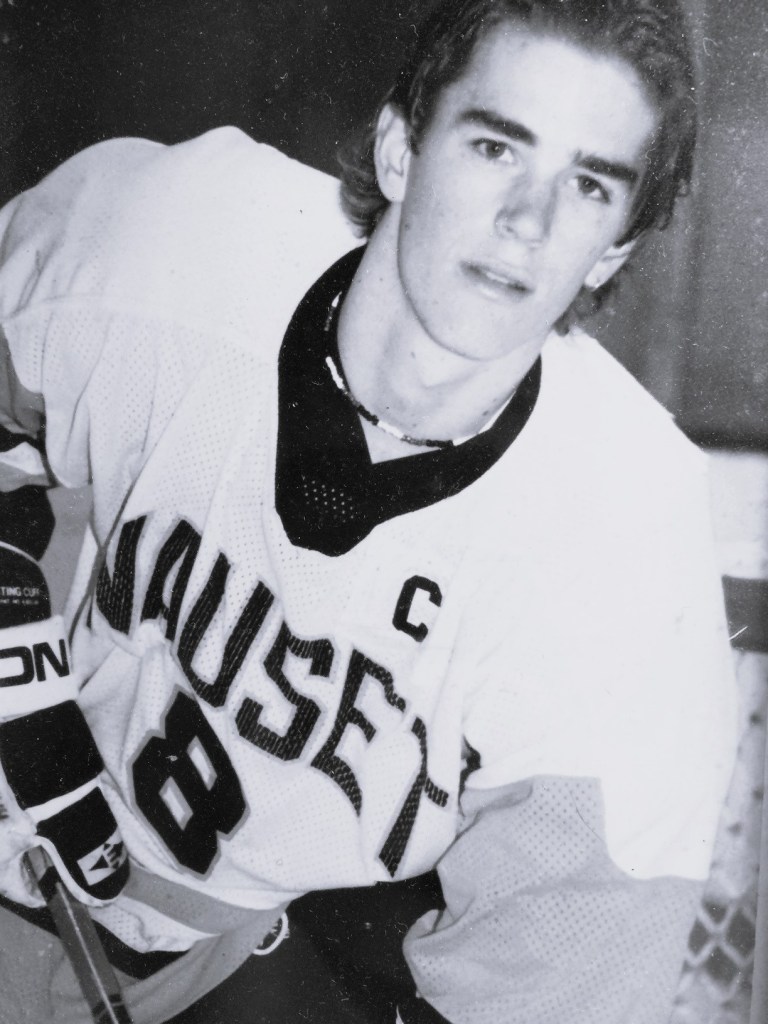
Harwood in his hockey jersey (notice the earring on his right ear!)
Sitting down in his first class of the day, Peter Harwood couldn’t help but get excited for his game after school. It was the first baseball game of the season, and he was more than ready to start competing again. He was impatient, but in science class, his favorite class, he could distract himself with equations and explanations, and when the day was over, then he’d allow himself to start thinking about baseball.
Harwood was a three-season athlete and also participated in a youth leadership program. He played baseball and ice hockey and ran cross country. His favorite at the time was baseball, but today he’s partial to ice hockey.
In high school, Harwood says he did well academically but focused more on sports than getting perfect grades. In 9th grade he took all advanced classes, but during his sophomore year dropped down to college prep classes for every subject other than math and science.
He preferred science over math because he says, “The way my brain works is I like to be able to explain everything. I like to have a reason something happens.”
When not focusing on school or sports, he would hang out with his group of friends. Harwood grew up on Cape Cod, which meant that during the school year it was quiet, with not many people coming and going, which meant he and his friends did a lot of outdoor activities. In the summer, there was no shortage of things to do when the tourists came. He scooped ice cream as a job over the summer and enjoyed the new influx of people to see and meet.
He took a math heavy job after college and then moved unexpectedly, at which point he took a job as a hockey referee and wanted to continue to gain experience to eventually make a living off the job. When he realized how much he enjoyed working with kids and figured out that he wanted to teach as well, he decided he could do both, which is how he became a math teacher at ORHS, and our boys ice hockey coach.
He wants to say to today’s highschoolers, “don’t panic if what your plan is now doesn’t work out… sometimes you have a plan and you get all bent out of shape when you don’t achieve it. Other things will pop up that you may end up liking better than original plan.”
-Sadie Goldberg and Hannah Klarov
Photos courtesy of teachers interviewed

 Mouth of the River
Leave a Reply