
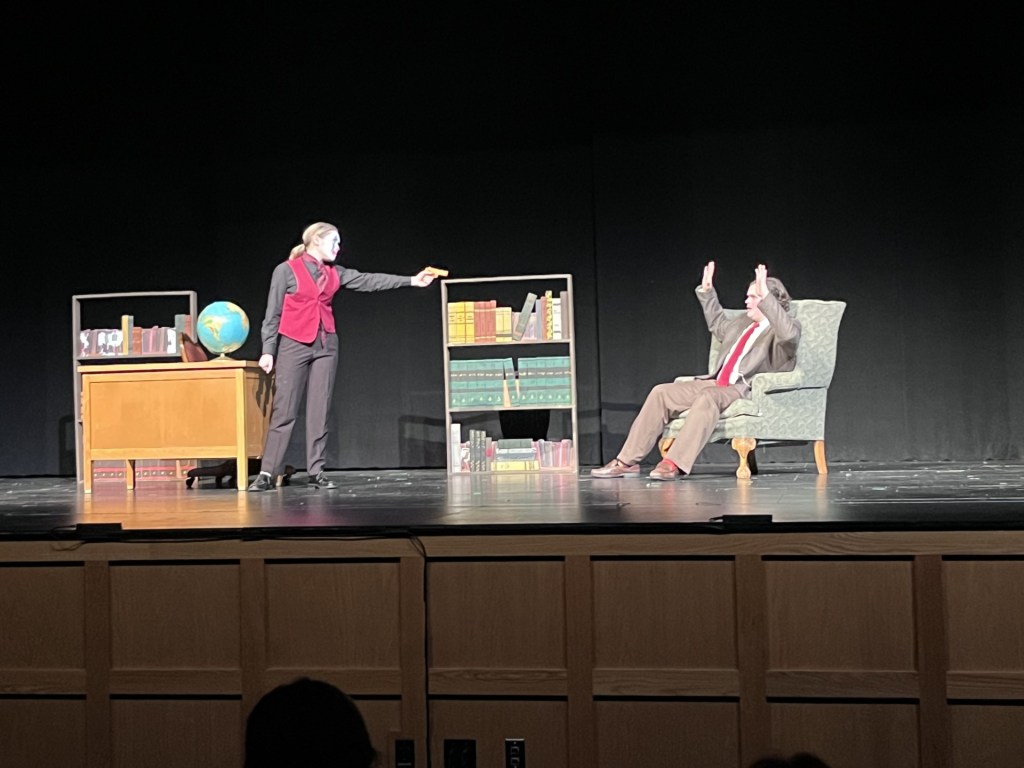
The audience is teeming with excitement, holding onto their playbills and waiting anxiously. Backstage it’s all nerves and last-minute preparations as the actors review their lines, find their props, touch up their makeup, and prepare for an hour and a half of mystery, murder, and clowns. The music fades, the curtains are pulled aside, the lights go up, and the show begins.
The Thirty-Nine Steps was originally an adventure novel, published in 1915 by John Buchan, later adapted into a film in 1935 and premiered as a play in 2005. The original performance consisted of only four actors: the male lead, the female lead, and two clowns that played every other character, which is about thirty plus individual roles.
For the Oyster River High School (ORHS) rendition, directed by Alex Eustace and Caroline Allen (’25), it consisted of a cast of nine people, making it three clowns instead of two. Levi Brandt (’25) played Richard Hannay, Zo Copeland (’25) played the three female leads, and Odin Whiteley (‘25), Isabelle Fenton (’26) and Madeline Healey (’25) were the three clowns that played almost every other character.
In addition, Lydia Bens (‘27), Clara Thorn (‘25), Claire Trezak (‘25) and Chloe Hatfield (‘25) filled in the rest of the ensemble as well as helping the tech crew.
The 39 Steps follows the life of Richard Hannay, a man living in England in spring of 1935. He becomes accidentally entangled in a complex spy scheme when he takes the fall of the death of a German double agent who is murdered in his apartment.
Trezak notes: “It takes you on a fun journey… there’s a lot of comedic shenanigans.” The rest of the play details Hannay’s zany and comedic travels across Europe while on the run from these mysterious enemy agents, portrayed by the clowns.
The show itself was written to be a fourth wall breaking and meta type of play, reminiscent to that of The Rocky Horror Picture Show, in the way that it is a parody of itself. The 39 Steps is supposed to be playful spoof on the classic spy thrillers of its time, convoluted schemes, clues and paper trails, enemy spies and romance. “You can’t spoof something if people don’t love it, and you can’t appreciate a parody unless you already know what they’re parodying,” states Eustace.
This in part explains the clowns and gags included in the show that add to the comedy, but it is widely accepted to be the type of play that the audience isn’t always supposed to understand. Eustace goes on, “you really do not have to understand it to appreciate it. The whole point is to abandon the desire to fully grasp things… just fully embrace the ecstasy of comedy.”
One of the most exciting elements of the show was the amazing and high-energy performances of the actors. Levi Brandt is on stage for the entire duration of the show and delivers a book’s worth of lines. His performance had especially good comedic timing and stunts, and his monologues were delivered with a captivating pose and cadence.
His female co-lead Zo Copeland had a similar run time, portraying the three of Richard Hanney’s romantic entanglements.
Her range as an actress was impressive as all her characters are wildly different. From playing a risqué German double agent, to a lonely Scottish housewife, to a self-righteous British lady, she breathed life into each of her characters. The way she fleshed out their personalities on the stage through their body language, accents, and facial expression added another layer of entertainment to the performance.

The three clowns featured, who played nearly every other character, were by far the actors that stood out the most, and not just because of the clown makeup.
Isabelle Fenton and Odin Whiteley were giving a hundred and ten percent in every scene, but especially in one scene that overshadowed the rest.
It begins when Richard Hannay is on the run and has gotten on a train to Scotland. He sits in a train car with two businessmen (Fenton and Whiteley) and much dialogue ensues. Eventually as the scene continues and the businessmen leave and come back as the train conductor (Whiteley), and a newspaper boy (Fenton). For the next five minutes Whiteley and Fenton take the stage in a whirlwind and switch back and forth between character to character, each one interchanging a prop or an accent to signify the change. This scene was full of chaos, overlapping lines, and props being thrown around. Despite the calamity, the two clowns more than pulled it off.
In Fenton’s words, “I had to get into the mind of and personalities of not only one or two characters… it’s thirty plus characters… it was really fun to figure out the different personalities.” It takes a certain type of talent to be able to switch back and forth while maintaining composure and remembering lines for multiple different characters at once. Whiteley and Fenton showed they have that talent and became a dynamic duo on stage.
The third clown that was featured was Madeline Healey, who made a grand entrance in scene two, where Richard Hannay takes a trip to the theater to see the famed “Mr. Memory” — a man who remembers everything. Out Healey waddled with maybe the biggest pair of pants she could possibly wear.
Healey and Fenton gave a huge performance, leaning into the dramatics of it all. Healey was featured in small scenes throughout the play, one of which she makes an appearance as a puppet, and then again in the finale of the play. Healey’s comedic performance continued throughout the play and comes to a head in the finale when Mr. Memory dies a gruesome death.
Aside from the actors, this play was full of impressive sets, lighting and sound, orchestrated by the tech crew and the stage manager Axel Freund (’25). Freund coordinated many of the technical feats and stunts that were included in the play. Freund held a long list of responsibilities, including sound effects, lighting, set design, costumes, hair and makeup.
“Set design… it’s so technical, there’s so much to think about. We have a great circle of tech people we’ve really got the hang of it and the rhythm of things,” states Freund.
One of the most impressive pieces of the set was the train. The “train car” was portrayed by a raised platform on wheels in the middle of stage. The platform includes benches, and a background meant to look like the inside of a train car.
During the scene, while the actors were on the “train,” stage crew stood behind and shook the platform back and forth to mimic the train moving along the tracks, along with added lighting and effects that were meant to imitate movement. The scene was immersive and aesthetic to look at, but this was blown out of the water when, during a part where Richard Hannay jumps out the “train window” to make an escape, the entire platform is turned around and suddenly the audience is met with the “outside” of the train with Richard Hannay clinging on.

This among other technical features were complex to design, build, and coordinate how they would become a part of the scene. “All these different things are meant to go wrong. It’s supposed to convey that loss of cohesion… but if you don’t do it well then things just look horrible,” states Eustace. Very consistently the technical aspect of the show gave the appearance of a well-oiled machine: smooth and effortless.
Since September the cast, crew and directors have put in hours of practice to complete their comedic and technical masterpiece. It was because of this that the audience was delivered a mind-boggling and hilarious spy thriller. In the words of Eustace, “My vision was to create a sense of absurdity and calamity… general mishap and mayhem, in a deeply unserious way.”
-Annie Graff


 Mouth of the River
Leave a Reply