
Returning students to Oyster River High School’s (ORHS) orchestra program have grown used to performing in a large ensemble in a location that constantly changed from room-to-room. This year, however, is different.
Headed by ORHS and Oyster River Middle School (ORMS) orchestra teacher Andrea von Oeyen, the orchestra class has undergone several changes this year. These changes have lessened the stress on the teacher, made the class more manageable, and allowed more individual focus on students. Even with concerns of balance and student vulnerability, the discomfort of a changed orchestra will only make these string instrument players stronger.
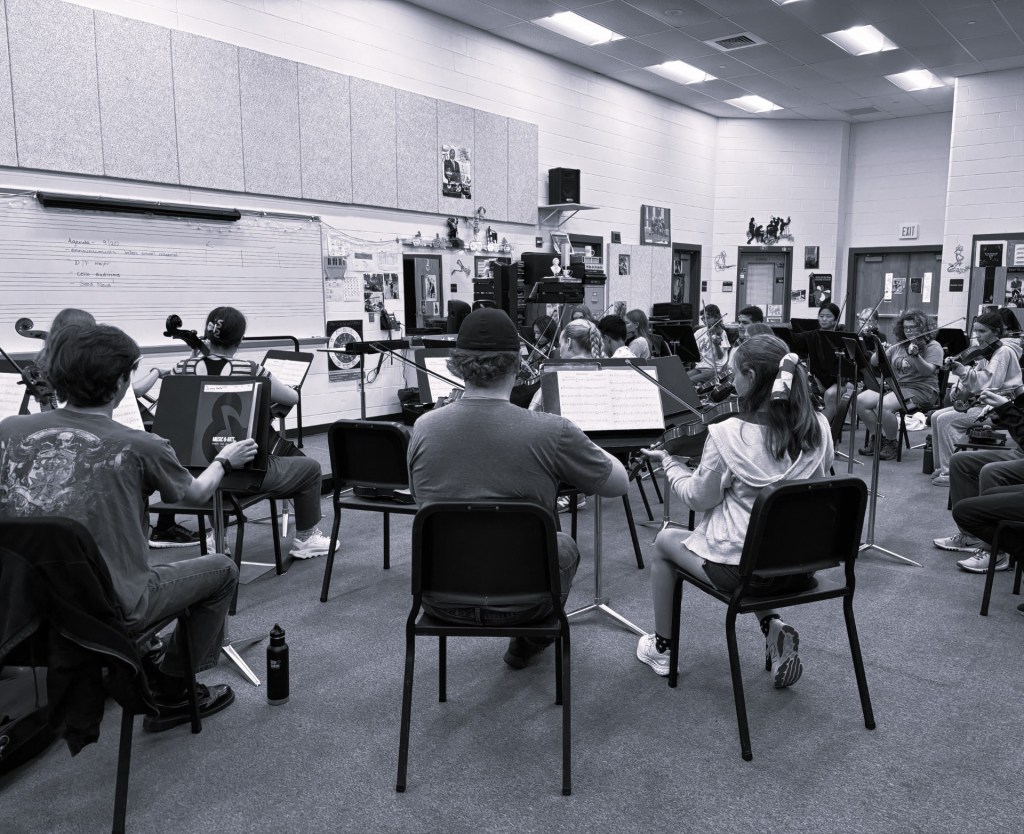
The formerly 55-70-person class has now been split into two sections (B4 and W4) and has been permanently moved to the band room. Von Oeyen now also mainly teaches at the high school with the exception of the 8th grade orchestra class.

Andrea von Oeyen mid-conducting.
Photo courtesy of Oyster River Cooperative School District
Dividing the orchestra in two was this year’s biggest change. It has been a long time coming: typically, high school classes shouldn’t be more than 20-30 kids, and the orchestra class was much over that limit, putting extra pressure on both the teacher and the students. “We split it so we can differentiate a little bit more for students to have smaller groups and have more individual time. It’s easier to help folks who need a little bit of extra help,” says von Oeyen.
However, Ike Williams (’26), a violist, thinks that what von Oeyen saw as a problem wasn’t so bad. “There was less attention on each individual, and larger groups meant we had more of [a range of] players,” says Williams.
Now that there’s two separate sections students can be scheduled for, players of different instruments are placed randomly, making the instrument distribution not ideal for an orchestra ensemble. One section has two students who play double bass, while the other has none, and one section has an overflowing number of violinists while the other barely has enough. This lack of a full orchestra and even distribution of players is a problem von Oeyen is combatting by scheduling monthly, before-school, full-orchestra rehearsals.

photo courtesy of oyster river school district
In class-time rehearsals, students aren’t used to no longer having the large sound of the group to cover up their mistakes. With more focus on the individual player, it pushes students to improve and avoid the mistakes that the larger group allowed for. “Before, in the big ensemble, you could dig into your strings and you wouldn’t hear the scratchy sounds—now you can hear every individual person in your section, which is a little bit overwhelming and intimidating, but I think we can grow into it,” says violinist Courtney George (’25).
Not only do this year’s changes to the program affect students, they affect the orchestra teacher as well. In previous years, von Oeyen ran back and forth between the middle and high schools to teach grades 5-12. Now, von Oeyen has a more workable schedule due to the hiring of the new middle school orchestra teacher, Carrie Young. “Traveling between two schools [was] a lot…keeping track of instruments for over 200 kids [was] a lot, especially these types of instruments where things break all the time, or kids need to size up [their instruments]… multiple concerts a year, festivals, it just was getting to be overly busy. I wasn’t feeling like I could handle all of it,” says von Oeyen.
Williams says that in the past few years, “Mrs. von Oeyen was a lot more stressed, with being a part of the middle school program and the high school program.”
Now, von Oeyen no longer has to go back and forth multiple times from both schools, reducing this stress by a mile. Instead, she starts her day teaching eighth grade then drives down to the high school to finish the school day. “Now that Mrs. von Oeyen is here [mostly] full-time, she has a lot of room to play with what she’s doing in the high school,” says George.
Because she’s at ORHS nearly full time, von Oeyen, now more than ever, needs a permanent classroom. Space has been an issue in the past for the larger orchestra, and its “classroom” has been many different rooms. The ever-changing orchestra classroom was difficult and not the best scenario for the class. String instruments can go out of tune with the slightest change in environment, and the best sound of an orchestra is really only produced in certain spaces designed for its sound. The auditorium can’t fit the orchestra onstage, the MPR isn’t built for the sound of string ensembles, and neither is the library, due to its carpeting.
This year, the group has permanently relocated to the band room. With the smaller sections, the band room fits the orchestra and enhances the ensemble’s tone quality. “I like the band room…it’s nice to be in a room that’s actually made for music,” says violist Maggie O’Shea (‘27). With von Oeyen’s office situated in the corner, eliminating her need for her traveling rollie-cart, all the student’s musical supplies in one spot, and a room that makes music sound its best, the band room is a welcome transition for students.
These changes are viewed in many types of ways: welcomeness, comfortability, and unfamiliarity. Nonetheless, the strings orchestra program is moving forward, and is ultimately improving. Von Oeyen is grateful for the community and administration’s willingness to make these changes and improvements.
“I’d love to say thank you for everyone who’s supported music or supported the orchestra,” she says.
-Paige Stehle


 Mouth of the River
Leave a Reply