

Hundreds of students from across the New England region gathered at Saint Anselm College to discuss philosophical issues ranging from artificial intelligence in relationships to the nutritional implications of what we feed our pets.
On January 25th, the College hosted the 2025 National High School Ethics Bowl (NHSEB) regional competition. The Oyster River High School (ORHS) Ethics Bowl team [Mason Gower (’27), Colin Weingardt (’27), Orion Smith (’27), Maren O’Keefe (’27), Morgan Kim (’27), myself, and our coach, Eden Suoth, ORHS philosophy teacher] joined the likes of Manchester West, Bishop Brady, and Franklin Academy.
As a co-founder of the ORHS Ethics team, I’ve been extremely privileged to participate in an event that fosters meaningful connections and intellectual growth. When we attend the annual convention, we leave with more than just new perspectives—we gain community building skills that extend beyond the competition.
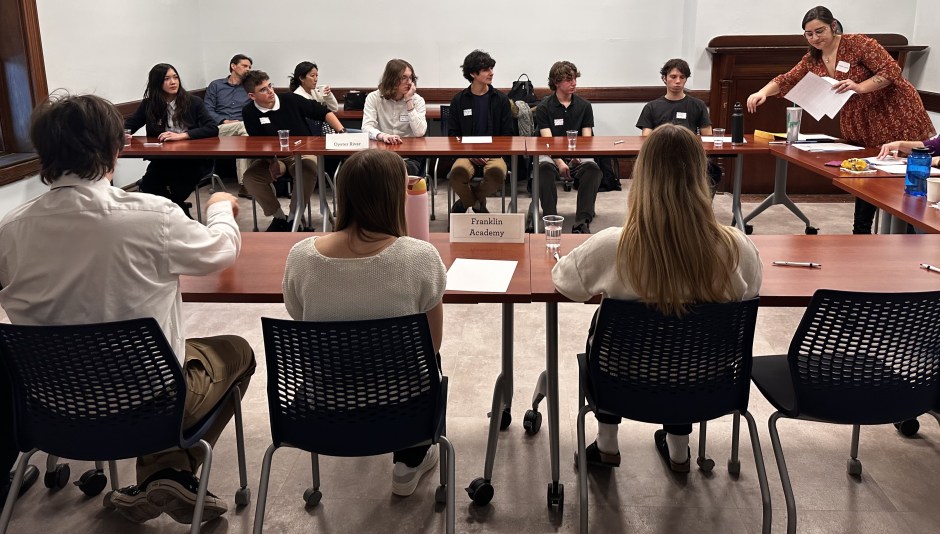
Moderator distributes case #6 “Don’t Worry, It Doesn’t Have Alcohol,” which concerns normalizing adult behavior for children, to us as we mentally prepare for match #1 against Franklin Academy.
Each year, Ethics Bowl teams analyze fifteen complex ethical cases, preparing logical and philosophical arguments to engage in a structured exchange of ideas. Some schools, like Phillips Exeter Academy (PEA), even offer classes to help students prepare. True to NHSEB’s mission of fostering “respectful, supportive, and rigorous discussion,” our matches challenged us to consider perspectives beyond our own.
Unlike Debate or Model UN, where participants argue assigned positions, the Ethics Bowl allows teams to engage with cases in ways that align with their actual beliefs. This format encourages collaboration, as teams integrate diverse perspectives into their reasoning.

We discuss during the two-minute conferral period before presenting case #14, “My Pal, Hal,” which concerns romantic relationships with artificial intelligence, against PEA.
Each round follows a structured format: after receiving a case, teams have two minutes to confer before giving a five-minute presentation. Then, they listen to a commentary from the opposing team, discuss their response, and answer a series of judges’ questions. While preparation is key, the ability to think critically on the fly—adapting to unexpected challenges—is what sets successful teams apart.
Our team has spent every Tuesday since early November practicing cases and simulating rounds. We even managed to scrimmage Manchester West, hoping to further hone our skills. But despite our efforts, we didn’t advance. However, winning isn’t at the heart of the Ethics Bowl experience.
A key aspect of the Ethics Bowl is admitting uncertainty. A skilled philosopher knows when to admit, “I don’t know.” In our final matchup against PEA, we tackled the question of whether AI can replicate human personality traits. When asked how we could determine whether AI is conscious, we responded honestly: first, we would need to define consciousness—something humanity has yet to do.
Aleah Ryan (’25), founder of Bishop Brady’s Ethics Bowl team, explained, “If you enjoy introspection and hate small talk, you will find some level of satisfaction in participating in Ethics Bowl. Whether or not you win, you’ll have the ability to have these deep conversations with people you’d never otherwise interact with.” I had befriended Ryan at the Future Leaders Institute (FLI), an immersive six-day UNH Summer Program in Philosophy, Politics, Ethics, and Global Justice. Ryan credits FLI for inspiring her to start her own team, saying, “I wouldn’t have known to found an Ethics Bowl team at my school if not for FLI.”
For students unsure about participating, Ryan offers this advice: “Do FLI. If you don’t know if you want to compete in a real Ethics Bowl, FLI is a great way to familiarize yourself with it.”
Even for those hesitant about competition, Ryan emphasizes the benefits of participating in similar organizations. She describes her experience in the philosophical world as “incredibly beneficial.” Beyond competition, Ethics Bowl helps students develop critical thinking and communication skills—skills that Gower, who joined the ORHS Ethics team this year after two years in the JV Socratic Society, feels he has gained. “I think I’m way better at public speaking now,” he says.
Ryan also sees a broader impact. She believes that engaging in ethical discussions goes beyond personal growth. “You’re doing a service to yourself and others by fostering these kinds of conversations,” she says.
—Ulysses Smith MOR
media courtesy of Eden Suoth and Nicole Smith


 Mouth of the River
Leave a Reply