
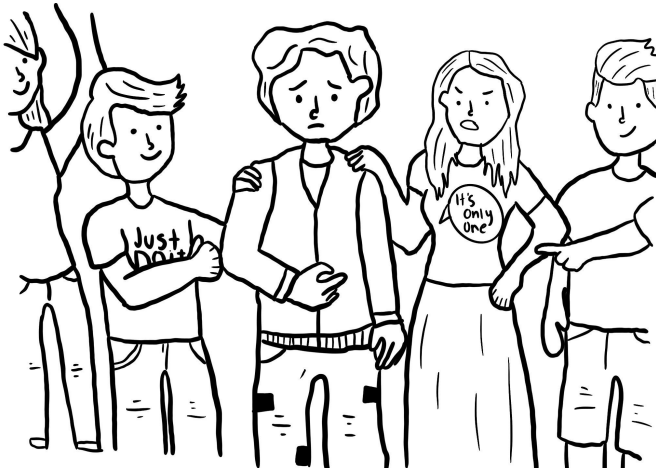
Due to the nature of the interviews and in order to disguise each generation, everyone interviewed will remain anonymous
As someone in high school, I have not only heard about but experienced peer pressure. After experiencing it myself, I wondered if people who are my parents, grandparents, or even my younger cousin’s age have experienced similar or totally different things than I have. So, I interviewed someone from every generation to find their experience with peer pressure and see if it has changed or gotten any easier.
It can be assumed that at least once in a person’s lifetime they \will be affected in one way or another by peer pressure, whether it is the indirect influence of other people’s actions, or the direct pressure and forcefulness from a peer. But writing this article I thought about how the stories from each generation made me realize, maybe it hasn’t changed, at least not in the way I initially thought it did
At first, I thought substance pressure situations were unique to Generation Z, but after interviewing C, a member of Generation X who talked about peer pressure and her experience with drinking and driving, it led me to believe the opposite.
“I was with a friend of mine, we were at a party, drinking with boys, and we didn’t have a good way to get out of the situation . It was more of who has been drinking less, who is safer to drive, so I drove because I didn’t drink as much,” said C.
The education on what C went through is more prevalent than in older generations, so it is discussed more amongst young people. “Who is safer to drive” is something Gen Z would’ve been taught is not right – since it’s still drunk driving. Now, driving under the influence is talked about in health class heavily, whereas for Generation X that is not the case. According to Oyster River’s licensed drug and alcohol counselor, Britta Bartlett, drugs and alcohol being talked about more frequently may also lead to more curiosity. But curiosity is not necessarily a bad thing. “I think curiosity is a great thing, the more curious you are the more answers you can get,” said Bartlett.
What helped me realize that peer pressure hasn’t throughout the generations was hearing from the perspective of a Baby Boomer, let’s call her R. Being one of the oldest living generations I assumed that when Boomers were my age, they were much more innocent than most kids today. But after interviewing R I realized I was wrong.
R had an experience where she said no to peer pressure in one way but gave into it in another. “She asked to borrow my purse to go into a store and steal, but I wouldn’t go in with her. So, she said give me your purse and she went in to steal things from the store. I had her clean out whatever she had in my purse, and I stopped hanging around with her,” said R.
Baby Boomers were once my age too, when peer pressure can be very common. I think her willingness to share their situation showed this was an older generation. It’s not likely younger Generations would be as open to sharing situations involving such a serious matter. Not to say that peer pressure has changed, but I think that at this point in time when two of the generations are mostly minors, they wouldn’t have the tendency to share rules they have broken quite yet.
While M’s situation is different, the action of giving into pressure is the same as the other generations. Smaller similarities like rebelling against their parents is what shows how peer pressure hasn’t changed throughout the generations. I believe that all generations can relate in one way or another to going against their parents.
M knows how it feels to be pressured into one thing not knowing it could lead to even more, from an experience when a pressured drive out of town led to sneaking into a hotel pool. “We took our car places our parents would not approve of… I snuck out after bedtime, and I went off into a hotel pool. That was a lot of pressure on me to do it,” said M.
I think increased awareness in social settings today influences younger generations to think twice about sneaking into places like hotels, but I do believe it is still very common. This specific example shows M’s awareness of knowing what she did was wrong, which I think all the generations can relate to.
Relating back to what I have been saying about peer pressure not changing, I think that all generations could tell you about being pressured into “silly things” when they were younger. But for E, who is part of Generation Alpha right now, that silly thing she was pressured into doing is the first thing that came into her mind when I asked her if she had ever been pressured into something.
Even in everyday life, peer pressure situations can occur. They can happen in places like work or home, but for E, it was at school. “Once, my friend forced me to tell their crush that I liked them, even though I didn’t, but I said it anyway and I regret it now.” Following that E realized that she could make her own decisions, even in situations where someone is pressuring you. “You have your own mind, and you don’t need to do anything anyone tells you to do,” said E.
Teaching the younger generations the importance of saying no in low-risk circumstances is important so that when they are older, and more serious situations arise they know that they can make their own decisions. Being Generation Alpha, E had heard how important it is before to not give into peer pressure, but it wasn’t engrained in her, and that led to her doing something she didn’t want to do.
Being part of Generation Z, W knows exactly how it feels to experience peer pressure today. What he didn’t talk about during the interview but differentiates Gen. Z from other generations, is social media. Being pressured into doing something that goes against things like school rules, or even the law is much riskier these days, in one click your life could be changed, and things like making a sports team, or in extreme cases getting into things like college or the military could be ruined. This shows the importance of saying no in peer pressure situations, especially now.
Drugs and alcohol are two of the biggest reasons individuals are pressured. W has experienced this pressure firsthand. “When I was pressured into smoking I kind of wanted to try it and that see how it was, but I it wasn’t fully my decision ,” said W.
Like other generations, Gen. Z knows the pressure surrounding drugs and alcohol all too well. Being a member of Generation Z, W understands that. There is pressure around partaking in drinking and smoking, but I believe that it helps that it is talked about so much. For some people knowing the possible negative outcome makes their conscience kick in which is why I think the action W took was not fully his decision, he knew he shouldn’t but the pressure from his peers was more powerful than his desire to say no.
Finding that power to say no is so important when it comes to drugs and alcohol. “Being able to say no is a skill especially with the amount of peer pressure that can happen [in high school],” said Bartlett. Bartlett also used an analogy that can help students stop their problems at the root of the cause. “If there are Oreos in the house, I’m going to eat all the Oreos. If I just don’t buy them at the grocery store, then I don’t have access to them,”
Looking at these stories overall I notice how peer pressure really doesn’t really change. Doing my interviews I thought that I would discover how peer pressure got easier, or harder throughout the generations, but I found that through generations the effect of time did nothing. The younger generations have the same pressure to do things they don’t necessarily want to do just as the older generations did.
One may think that as a generation ages, peer pressure gets easier. But through writing this article I learned that it’s the generation that changes, not the peer pressure
-Bella Jackman



 Mouth of the River
Leave a Reply