
Imagine a world where diseases can be eradicated with simple genetic tweaks, crops can grow abundantly in harsh climates, and renewable energy sources are produced from everyday waste. This isn’t the plot of a science fiction novel; it’s the reality of biotechnology.
Biotechnology is revolutionizing the way we address some of the world’s most pressing challenges. From developing lifesaving medications to creating long-term sustainable solutions, this field merges the principles of biology and technology to push the boundaries of what we know to be possible using science.
These limits are being challenged right here at Oyster River High School (ORHS) by the new BioBuilder club.
BioBuilder is an independent nonprofit founded by a research team at the Massachusetts Institute of Technology (MIT) that provides an opportunity to high school students to combine engineering and science to design, build, and test their own unique ideas. Teams receive funding to develop a project that they’ll eventually present to judges at a national competition.
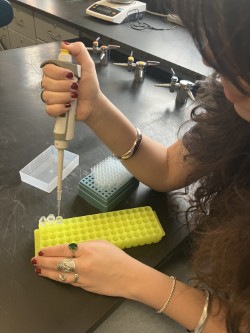
The club correlates closely with the new biotechnology class (Intro to Biotechnology) taught by Megan Thompson and explores ways to introduce students to the field of study through hands-on, interactive experiences. “Bio tech is the cutting edge of technology and New Hampshire is wanting to grow its workforce,” says Thompson. “Most of these concepts are ones that people don’t typically see until college, so I’m trying to move some of those into the high school and maybe even middle school level as well.”
As Thompson states, due to students’ limited exposure to biotechnology in their secondary education, it can be difficult to find high schoolers with profound interest and knowledge in such topics. However, this club was founded entirely by one student: Juliana Kun (‘26).
Kun reached out to Thompson with hopes of gathering a group of students to form a biology club after a summer research program with BioBuilder rekindled her passion for the subject.
Kun says, “I’ve always been interested in biology and once I learned about synthetic biology and biotechnology, I realized that it has so much potential to change our future and impact our world.”
Kun is not alone in her views. Felix Scarlat (‘26) was excited when asked to attend the first meeting. He says, “[The] BioBuilder [club] was a unique experience that I couldn’t find in any other club.” Scarlat shares Kun’s affinity for the field saying, “[Biotechnology] is pushing science to its absolute limits with what we can do with nature and human life. It’s fascinating how we can program living organisms to do what we want them to do and that’s interested me from the very start.”
The club has spent their first few weeks researching and defining their project, arguably the most vital stage of their development plan. “BioBuilder is set up so you develop your own project. [The study of] biotech is large and all encompassing; you can do everything from agriculture, to marine, to environmental, to developing pharmaceuticals, to medicine…so the club has spent the first part designing a project and what we’d like to focus on,” says Thompson.
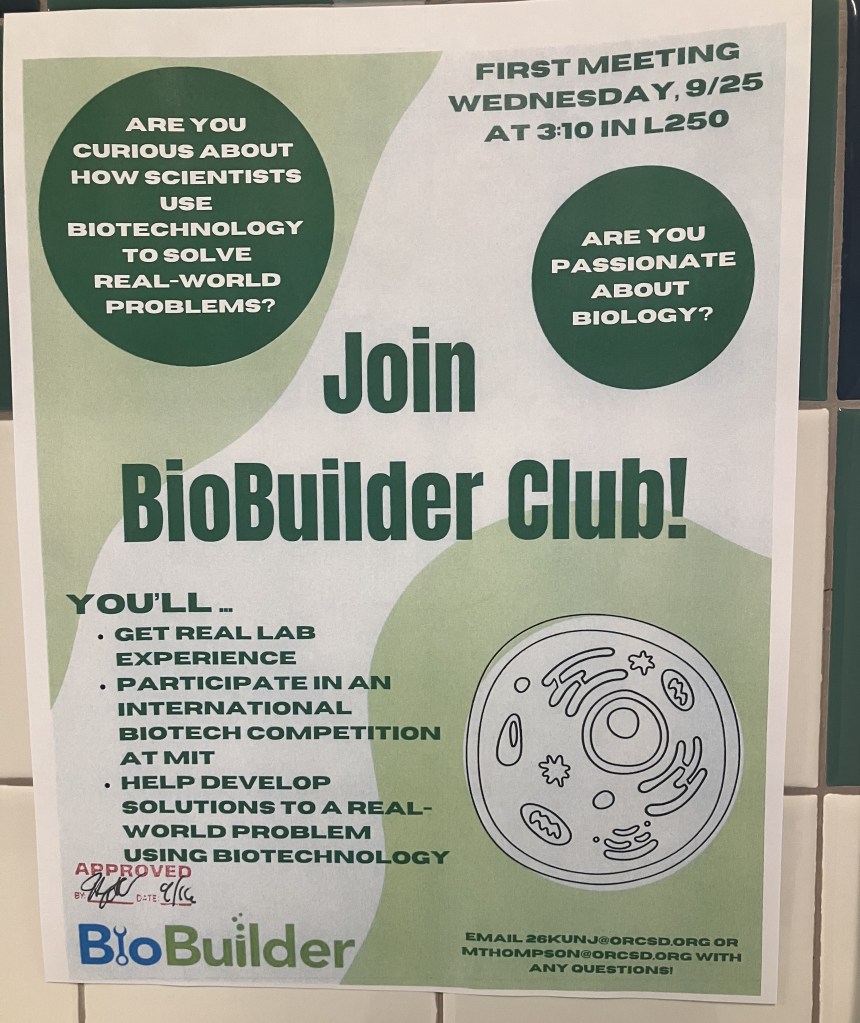
What this looks like for the group is deciding a specific area of biotechnology to study and developing a research plan which will shape the focus of the club for the next several months or even years.
Kun says, “We want to be able to design, build and experiment on some sort of bio-engineered organism. For us, we think that’s going to look like spending a few years on the same project.”
She shares their idea of studying the regenerative properties of a genus of flatworm known as Planaria. “We want to observe what in its genetics lets it do that and if it can be implemented in humans.” With enough time and resources, this could be the first step to developing groundbreaking biotechnology research that can be used in modern medicine.
However, it will be a long process. “I’m hoping to put together a good amount of research that we’ve already done so that once I graduate, whoever takes over will be able to have a clear pathway to see what we did and what can be done in the future,” says Kun.
The BioBuilder club is offering students the opportunity to make a real difference in the world and jumpstart their own future.
Targeted towards those passionate about making real change, this club – the first of its kind here at ORHS – offers an immersive research experience to any future scientist.
For now, the club will continue to refine their project before they present the beginning stages of their idea at MIT.
-Jahrie Houle



 Mouth of the River
Leave a Reply