
Saturday, November 9th, 6:30 AM
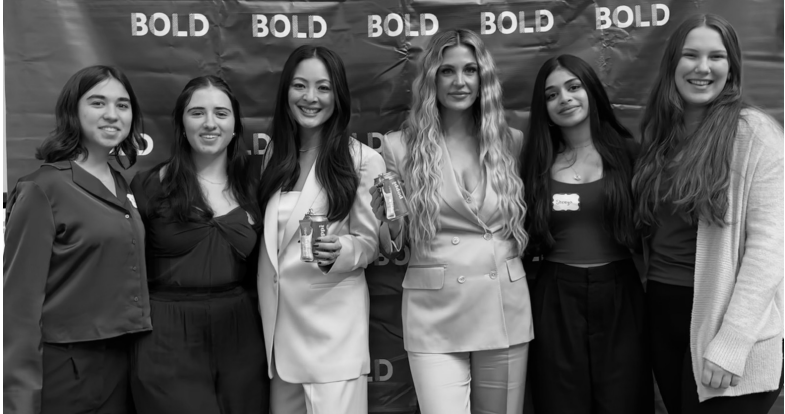
A barely awake Courtney George (’25) typed in the address to Harvard University’s engineering building in my phone’s GPS. She sat passenger, with Shreya Joglekar (‘25) and Maya More (‘25) in my backseat, all of us wearing our business-casual-est outfits.
We’d be spending the next two days at Harvard for the Business Oriented Leadership Development (BOLD) conference. 2024 marks the 8th year of the BOLD conference, but it’s the first year ORHS has sent student representatives.
Two weeks prior, Sean Peschel, ORHS ELO Coordinator, had delivered a note to me and Shreya during our Spanish class. All that was written was to come to his office during Flex. When we walked in and joined the group of a few other senior girls, Peschel had a vague pitch prepared.
At first, I wasn’t too intrigued by the idea of the BOLD conference. He had said something to the effect of “listening to empowering women in business” and all I pictured was “spend two days hearing women drop buzzwords in speeches about why I should change my goals to becoming a businesswoman.”
Yeah, I know it was a little pessimistic. That’s why I keptit in my head instead of telling Peschel. I’ve been to enough bad quality conferences to warrant at least a little apprehension towards these things. But, I trusted Harvard enough to give it a shot.
Saturday, 8:30 AM
Despite me making the same wrong turn in a Boston parking garage for a solid three minutes, we weren’t behind schedule.
Courtney, Shreya, Maya, and I stepped in the check-in line behind a pair of friendly girls. We started talking about the New England irony of the Dunkin’ coffee cup still in my hand, looking at a table piled with munchkin boxes.
In line I learned that the Harvard Undergraduate Women in Business program had spent the past 11 months planning this conference. The tickets had sold out, with 300 high school girls in attendance and even more ready to watch on a livestream.
I remember saying something like “holy cow,” looking at Courtney as we both realized how during Peschel’s ambiguous pitch to us, his trust in the conference might have been justified.
Saturday, 9:00 AM
Everyone sat down in what I imagined to be a typical Harvard lecture hall, 300 auditorium style plush seats with lap tables that fold out from the arm rests. I sunk down into a seat a few rows from the back of the room. I grumbled a little when opening my purple BOLD branded notebook and wrote down the headline for the first item on the schedule, feeling a familiar sense of doubt when I saw the ‘boss lady’ title.
Fireside Chat: Superwomen Allison Ellsworth and Amy Liu.
Allison and Amy took their seats in front of a simulated fireplace, in matching pink and purple blazer sets. While I didn’t recognize them based on names alone, their introductions surprised me. I hadn’t actually been expecting to know the brands, let alone have tried any of their products.
Allison, CBO and co-founder of Poppi, described her business growth, which started over all nine months of her pregnancy. She was approached by Whole Foods at one lucky farmers market stand, and Poppi has since been pushing itself onto grocery store shelves all over the world.
She told us all to look under our seats, where I found an orange can of Poppi, along with yet another goody bag.
Just as I pulled an orange lip treatment tube out of the bag, Amy introduced herself as founder and CEO of makeup and skincare brand Tower 28, the only American beauty brand to 100% comply with the National Eczema Association.
Amy turned to the audience to deliver her all-encompassing message, “figure out your lane, become great at it, and don’t stray from your values… whatever it is, think about why you care, and be clear about that the whole time.”
After saying that, “Ego gets you nowhere. Surround yourself with people whose strengths are your weaknesses,” Allison finished off the segment by filming a clip for her series of TikToks she’d post about the day.
I had at least a little bit of new excitement about the rest of the day. Maybe it’s because my caffeine had kicked in, but more likely it was how well this first panel had landed, and I could feel everyone else in the room agreeing with me.
Saturday, 10:30 AM
Wholesale product distribution does not excite me. So, I’ll admit, when the screen displayed the description of Keynote speaker Kathleen Mazzarella, CEO and president of Graybar Electric Company, I was ready to tune out.
But at the end of the speech, Shreya reached into my notebook and wrote “she’s an actual diva.” Kathleen was an electric speaker, and not just because that’s in her company’s name.
This spark had taken her far. At only 20, Kathleen became the second woman salesperson at Graybar, and as a “driven and aggressively aware” person, she announced to her boss that she would become the president someday. She told us how years later, he let her know he believed in her immediately.
I listened to every word. Even what I would normally find cliche was inspiring, because I actually felt that she believed in it, like when she said, “Every single setback happens for a reason. You can’t get too comfortable when it’s good and easy; look for the challenge.” I felt like anyone could have said that sentence, but Kathleen set herself apart when she backed it up with real stories of failure.
She told a few stories that led back to the same character, Dennis. He was a less qualified man who wasn’t making her numbers in sales but beat her for promotions over and over again. Kathleen shared that the reason given to her was that the company wasn’t ready for a woman on the board. So, she ran for presidency. When it came down to the final two candidates, she finally beat Dennis, who promptly quit.
Even without our own “Dennis” to compare to, most of us girls in the room probably would have agreed that we’ve been told to be cautious around men in future workplaces. I’ve heard in so many different ways to “never gloat” or “don’t let them know you’re doing better than them.” It’s discouraging, but the solidarity in the room was real.
After, she took on a lighter tone and casually shared a few hobbies that she took up when getting angry at the men she worked with. Easy and relatable things like running 10 miles, taekwondo fighting, and skydiving.
Some of what she said I’ll think about for the rest of my life, including how, “leadership is about everybody else but you. You don’t need a title to be a leader, you just have to figure out what everyone else can do and help them shine. Leaders move someone else forward.”
This quote was honestly the first thing I wrote down in my notebook that felt like it mattered to me. I’m writing this article for the magazine that I’m at the head of, so it felt fitting to be pushed into a bit of reflection on what a leader truly does.
Saturday, 12:00 PM
Lunch was yet another Poppi, a bag of popcorn, and catered sandwiches from Tatte, one of Boston’s only women owned bakeries. Good enough that I ate my sandwich and half of Courtney’s.
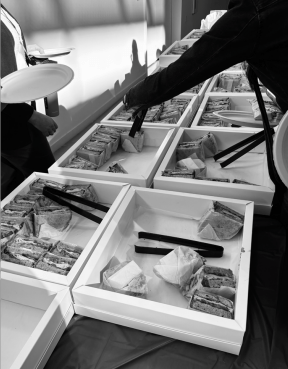
Tatte bakery sandwiches for lunch
I was starting to understand why it took 11 months to plan the conference. Every detail was there. Even the popcorn was supplied by a female owned brand, instead of a bulk alternative which could have fed 300 teenagers for a lot cheaper.
Shreya, Courtney, Maya, and I had a conversation about how most of our original apprehensions were fading. I entered the afternoon sessions feeling like I had accomplished some sort of hidden goal of the conference, with more willingness to listen to the remaining speeches and panels.
Saturday, 1:30 PM
Empowerment and Entrepreneurship were the biggest words of the day. The panel hosted by author and podcast host Grace Beverly, gave us definition to these words, and how to apply them.
The 23-year-old woman who’s earned her spot on the Forbes’ 30 under 30 list, made her start not much older than all the girls in the room. She emphasized how starting any kind of huge goal young teaches you how to make mistakes, since not everything will work out the first time you try. “It’s ok to take small steps and be hesitant. The best advice I can give you is to be realistic,” said Grace.
I might have been one of the only girls in the room who wasn’t outright planning on starting my own business one day. Originally, I had thought that might be the barrier to me gaining anything worthwhile from the conference altogether. Grace’s segment was the one that most clearly was connected to real advice about startups and investments, but I took with me a new drive as a young woman. Grace was that real life example of being a teenager with goals who was taken seriously enough to go somewhere with them.
Saturday, 3:00 PM
We’d been at Harvard now for the length of a whole school day. Any feelings of boredom were forgotten as soon as a clip of the movie Wonka kicked off the group workshop.
Even though I was confused by the connection to entrepreneurship, I gave a silent kudos to the planning process. It felt nice to know during the 11 months of planning, effort was put into finding what high school girls might relate to, instead of just jumping into our workshop activity.
Timothee Chalamet’s version of Pure Imagination somehow was the perfect segue. In groups, we were given a list of household items ranging from a measuring tape to a single paper towel.
The goal was to market one ordinary item to sell as repurposed to a different group of people. After a quick introduction from the two girls sitting to my left, we decided the ice cube tray could, and in fact should, be instead sold as a ravioli stamp.
The two New York City girls and I both shared the same opinion. The ravioli making process is severely lacking in efficiency and we’d eat a lot more ravioli with a quicker method.
While it sounds a little dumb to draw large comparisons about business from ravioli, I fully understood the point of the workshop. Entrepreneurship means being the person to take risks with an idea.
Oh, and the girl next to me walked away with a full-size bottle of Olaplex shampoo she received for sharing our idea with the larger group. I walked away scratching my head about how they had afforded all these goodies.
Sunday, November 10th, 9:00 AM
Once again fueled up by new Dunkin holiday coffee, Courtney, Shreya, Maya, and I signed in for day two with a little more excitement than we had 24 hours ago. We’d spent the whole car ride home the night before discussing just how much the first day had exceeded expectations.
So, when we entered the lecture hall to settle down for the second day’s sessions, the four of us sat a few rows closer to the stage.
Day two’s first panel was titled Social Impact and named two women who worked for companies I once again hadn’t heard of: Ashley Leftwich, CEO of Rock the Street Wall Street and Katherine Mccord, vice president and community lead of HarbourVest Partners.
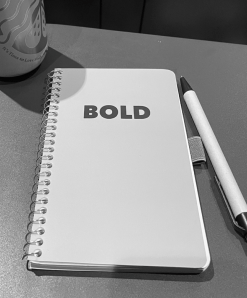
My conference notebook
Before Ashley began to describe the mission statement of her organization, in my gut I expected some shallow bragging about being a nonprofit founder, and almost gave Shreya an eyeroll or similar look. Pleased to say, I was wrong. What I heard instead was real success stories of young women who had gotten their foot in doors of financial and investment mathematics, very typically male dominated fields.
Katherine, a woman holding a high-level position at a similar financial industry, described the fear of entering these fields. She said, “You see only men in suits in TV and movies, hear stories, but there’s so many opportunities for women… We’ll always feel the challenge of coming across aggressive for being strong willed and decision makers, but you have to just try to push forward without worrying about it.”

The Harvard University lecture hall hosting the BOLD conference.
This segment connected a lot to the overall idea: why have a conference dedicated to empowering young women? I think at this point my answer was no matter how much people in our lives try to give us advice and encouragement, it doesn’t usually stick. What does is hearing real stories of the women who were all bright eyed 17 year olds once. I don’t necessarily want to own any of the businesses they all do, but their goals aren’t so far off. Everything starts with being able to get your foot in the right door.
Sunday, 10:30 AM
My notes now filled the first 17 pages of my new tiny notebook, and we’d arrived at the very last session of the conference. One final panel, titled Self Love and Beauty, featured Adriana Carrig, founder and CEO of the Little Words Project, and Laura Schubert, founder and CEO of Fur.
Adriana and Laura both discussed the double-edged sword to a business that is social media, which had already been a huge talking point throughout the weekend. Both of their brand ideas were created through negative experiences with social media, received backlash via social media, but wouldn’t come anywhere close to their current popularity without it.
It all felt very relevant to the girls in the room. I’d make an honest estimate that at least 250 of us are on social media enough to see the real effects it’s already having on consumerism. So it was nice to hear Laura, one of those online business owners saying, “I don’t push products like ‘women, you need this’ which is so much of what we see online. Hyper consumerism is huge. Instead, let the customer decide what will help them.”
It was all so trustworthy because you don’t see a lot of products made by women and advertised towards women this way.
Sunday, 1:30 PM
31 hours after leaving my house for a conference I knew roughly nothing about, I pulled back into my driveway with more than just the $150 worth of product from the brands of the women who spoke during the weekend (yes, $150 worth of Tower 28 makeup and more. Courtney and Shreya calculated it all while I drove home).
While it would be far too lengthy if I wrote analysis of all the segments we sat through, Courtney, Shreya, Maya and I discussed full detail of every moment during the car ride back home. Things like the woman who designs for Spotify who told her story through song quotes from artists like Charli XCX, or the baker who had started the business that catered all of our sandwiches for lunch.
I think what made it all worthwhile was the realness. They were giving us products, we were eating their food, but they were admitting to failures and telling true stories. Those original doubtful thoughts I had about buzzwords and false advice were wiped entirely.
Without even knowing I was missing it, I had been given a new sense of confidence as a woman to become an advocate and a leader.
-Amelia Rury

 Mouth of the River
Leave a Reply