
From answering a quick math question in the hall between classes to putting up cafeteria chairs during FLEX overflow, Greg Spiers, Oyster River High School (ORHS)’s newly appointed substitute coordinator is always willing to help. “When I’m here, I want to be available to help in the way that I’m most useful,” says Spiers.
But Spiers is no stranger to ORHS. He originally joined the district in 2021 as a long-term substitute for science teacher Tracey Benkosky. She commends his resilience and adaptability, saying, “Spiers really stepped up to a tough situation.” Since then, he has filled countless roles in the high school, including teaching computer science, running the math lab, assisting with summer credit recovery, and tutoring struggling science students, to name a few.
“He’s one of those teachers that cares about you as a person,” says Anjae McConnell (’25), who was in Spiers’ biology class as a freshman. His approach to education is rooted in his own experiences with perseverance, shaped by his grandfather, a retired principal and math teacher.
“He sat me down one weekend and permanently turned me from a D+ or worse math student to an A- or better math student,” says Spiers. “He made me grind through problem sets, silently erasing my mistakes and making me do my work over and over until I got it right.”
This lesson in resilience has stayed with Spiers, and as McConnell recalls, it’s evident in his classroom. “Spiers is willing to sit down with you and say, ‘No, you’re wrong, do it again, do it again.’” She also emphasizes how he reinforces the idea that your assignments don’t represent your value as a person and that he wants you to succeed.
Spiers explains that because of his experience with his grandfather, he can see the potential in many of his students. “Even if they think they can’t, I know they can, as long as they have the right kind of support and the right attitude. I know because I was once like them.”
Like McConnell, Alex Eustace, English and theater teacher at ORHS, also appreciates Spiers’ contributions. He highlights Spiers’ combination of expertise and teaching ability. “There’s a real difference between being an expert and being able to teach people. Spiers is both, in a way that not a lot of people are.”
But Spiers wasn’t always focused on education.
After studying Biology at Marist College, he moved to Boston to work for boston.com as a web designer and data analyst. While there, he began to wonder if his skills might be more useful in scientific research. So, he left for Boston University (BU) to study bioinformatics.
While at BU, he began working part-time at a local high school. He was halfway through his last year of graduate school at BU when he realized much of his research would likely be devoted to problems that already had solutions rooted in education.
This once again left him questioning the impact of his work and shifted his focus to education. “I felt like I could do more good as an educator than as a scientific researcher, because if I work in education, maybe fewer people will have problems and I can inspire more people to develop solutions, right?” he says.
Eustace praises this dedication, saying, “I don’t think anyone can dispute that Spiers, above all else, wants to help others and make the world a better place.”
Spiers grew up in a small rural town in the Hudson Valley of New York. “My father was a cabinetmaker, and my mother was a principal’s assistant,” he says. “Both are also lifelong volunteer first responders and active community members. Their example gave me my strong sense of community and desire to help others.”
And his selflessness shines in unexpected moments. Not only does Spiers put students first in the context of school, but he even turned down an opportunity to perform at Coffee House last year. “He kept saying, ‘No, no, no, this is for the kids,’” recalls ORHS writing tutor Jake Baver, “And I kept saying, “You don’t understand, Spiers. The kids are gonna go nuts if they hear you become Animal from the Muppets on his drum kit.”
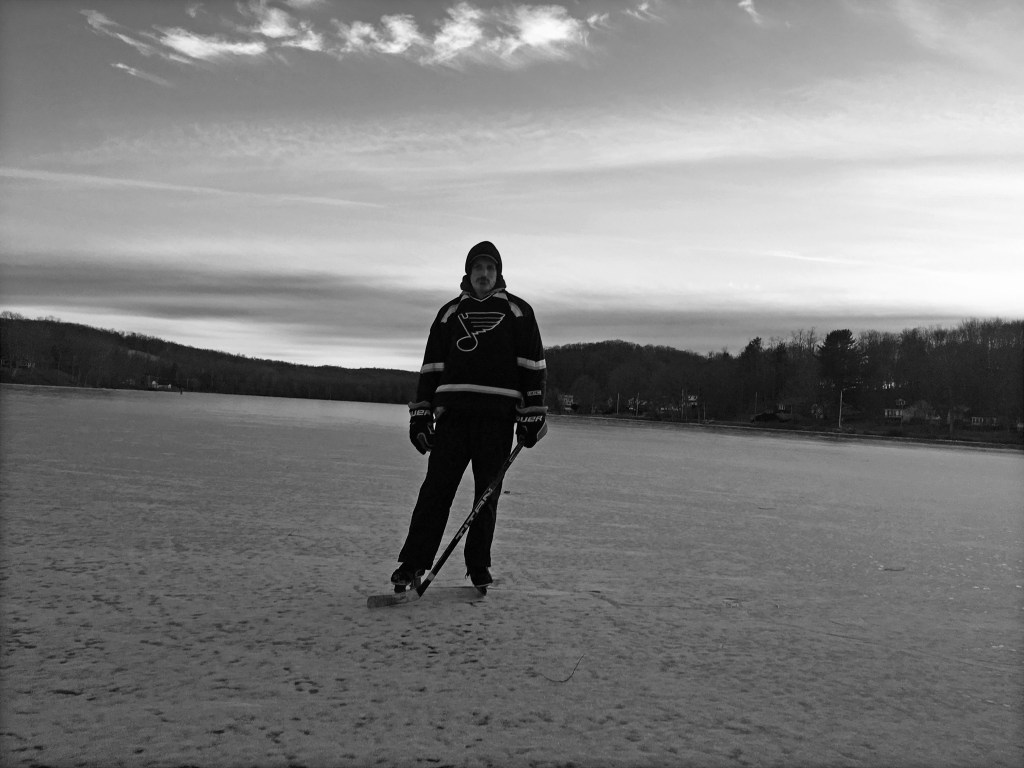
But Spiers is more than just a dedicated educator. He has a variety of interests outside the classroom. In addition to his hidden talent for percussion, he also enjoys studying paleontology, playing hockey, and organizing life into spreadsheets.
“I’ve run into some of my students at the rink, both figuratively and literally,” says Spiers. “We come back to school and they’re like, ‘Oh, wow, you broke my ankles and buckled me. You know what? You’re okay. Can you help me with my stoichiometry now?’”
But he’s not just a chemistry wiz, he’s also a Master of Data.
“Spiers understands spreadsheeting in a way that I will never understand any program in my entire life,” says Baver. “I watched him as he created a spreadsheet, and it was like Mozart composing music.”
Those who understand Spiers know that for him, it’s all about creating order and purpose. “At the end of the day, it’s just boxes, it’s just cubes and squares and cells on a spreadsheet,” says Eustace. “I think somewhere along the lines, that man understood that human happiness and fulfillment and morality fit into a single box, and he is constructing the box before our very eyes.”
This sense of structure extends to his view on teaching, as Spiers believes that educators must not only focus on the present world but also consider the future.
Spiers was very interested in two things as a young child: dinosaurs and the titanic. He first read Jurassic Park when he was about ten and was thrilled by the fact that the dinosaurs were not the result of magic, but rather science and technology. He wondered, “If we could recreate dinosaurs, what other seemingly impossible things could be made possible?” That realization sparked his lifelong interest in biology and genetics. Many of his students will recall him displaying Arthur C. Clarke’s third law in his classroom: “Any sufficiently advanced technology is indistinguishable from magic.”
When he was a long term-substitute for Intro to Computer Science, he would end each class with a short video of a recent technological breakthrough, ranging from using wireless technology to overcome paralysis or using machine learning to teach a robot how to play soccer. He says, “I think that something we always need to be aware of when we’re learning [is that] we’re not preparing for the world we’re in today, but for the world we’re going to find ourselves in tomorrow.”
–Ulysses Smith MOR
–media courtesy of Greg Spiers

 Mouth of the River
Leave a Reply