
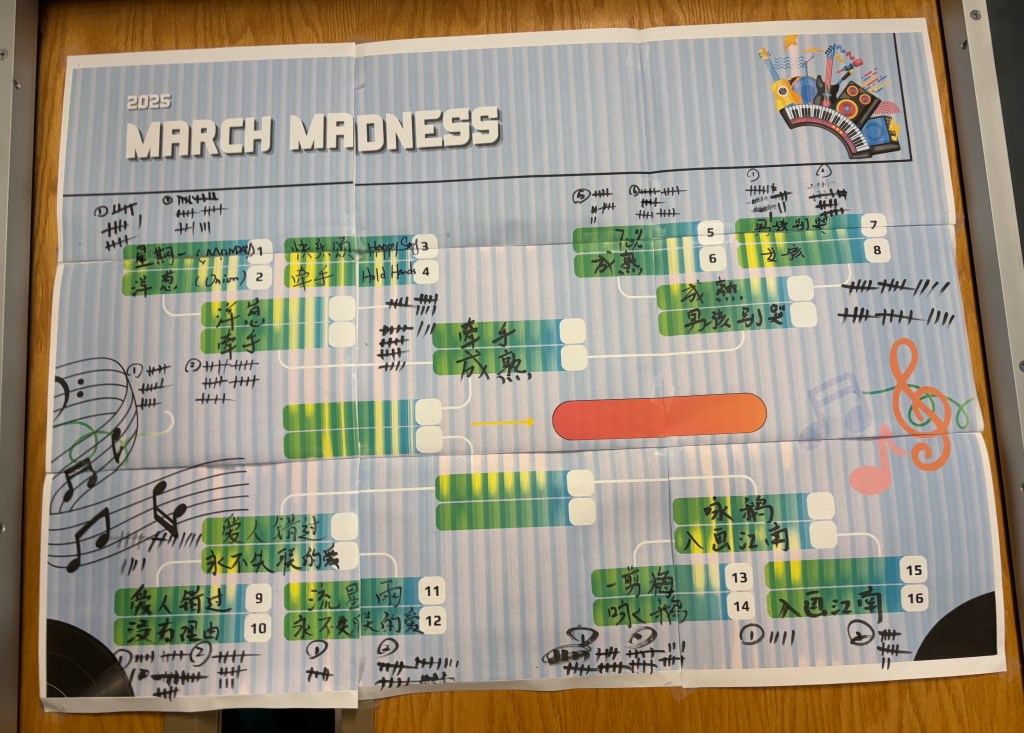
As March rolls in, madness begins to occur. Brackets get filled out, causing squabbles between friends after the chosen winner has lost to an unpredicted favorite. But instead of Duke and Auburn in their final four, they have “Como Paso” and “Minimum Ca.”
Each year, the Oyster River High School (ORHS) world language teachers spark the classes’ excitement when they run the French, Spanish, and Mandarin music versions of March Madness: Manie Musicale, Locura de Marzo, or simply March Madness in the Mandarin classroom. This event enhances the learning of these languages and fosters a more engaging classroom environment, increasing participation. The cultural aspects are also prevalent: students complete activities about the artists and the various countries they are from.
“Instead of the 16 teams [of March Madness], it is 16 songs, and then the students vote on them,” says Heidi Sant, ORHS French teacher. For Locura de Marzo and March Madness, the votes from the class are projected on the board, and for Manie Musicale, the creators make announcement videos that are shown in class.
“It’s kind of a nice change of pace. I feel on its own, French is a universal language, so even if the students don’t understand every part of it, it gives them pieces and structures that can get stuck in their heads,” says Sant. The event creates a fun space for the students but doesn’t stop them from learning.
Wendy Gibson, ORHS Spanish teacher, says, “I do spend time at the beginning of class, usually on the lyrics, or I might talk about the artist a little bit. They might not even realize it, but they’re getting something either grammatical or cultural.”
The class isn’t just about learning the language but understanding the culture. Students should be able to know the geography of the countries the songs are from and learn about the food, values for living, and culture surrounding music.
Lisa Fan, ORHS Mandarin teacher, says, “We talk about how sometimes the lyrics can get hard for students to understand, especially when they love rap songs. Sometimes we compare romantic songs, where we talk about what the people would do and how they talk about their feelings, compared to U.S. songs. Sometimes we talk about parenting styles, so there are lots of cultural components we talk about.”
Sant also talks about how the event expands students’ cultural knowledge, saying, “For American students, there’s a tendency to only listen to English music, so I think just giving exposure and a comfort level of listening to music in a different language is good.”
The music creates a spark of joy and happiness for the classes. Victoria Zlotosch (’27), in the Spanish 3 class, says, “We’re pretty calm but we have a lot of fun doing it.” Levi Clapp (‘27), in the French 3 class, shares the same opinion, saying how it’s “usually pretty relaxed.”
Both Gibson and Sant appreciate the class’s participation, because it makes it easier to teach if the students are invested. “When the class favorite would get knocked out, there would be a reaction, but that didn’t bother me because they were invested,” says Gibson.
Even though the competition is loved by many, there are still some aspects that both teachers and students tend to dislike. Teagan Nadeau (‘26), in Spanish 4, shares how she feels that the excitement sometimes can take away from the learning side. Her class focuses more on music and having fun compared to learning and dissecting the lyrics. Clapp agrees, saying, “I mean, I learned about the artist, but nothing big.”
The songs can also bring some controversy. Gibson says, “This year is not my favorite year for music. There are some good songs, but for me there’s not a slam dunk.” Nadeau and Clapp agree, mentioning how past years have had better choices and no songs this year can compare to last year’s lineup.
Despite this, “Como Paso” and “Celia” for Locura de Marzo and “Minimum Ca” and “Sois Pas Timide” for Manie Musicale have taken center stage for the French and Spanish classes, being the winners on nearly all brackets.
Each year, Locura de Marzo, Manie Musicale, and March Madness bring a new way of learning Spanish, French, and Mandarin into the classroom, which both teachers and students look forward to. The lesson doesn’t just stay in the classroom but continues through the memories of the music. Gibson shares, “I have so many older kids who’ve told me that they’ve added [one of the event’s songs] to their Spotify playlist and that makes me so happy.”
-Thea Smith



 Mouth of the River
Leave a Reply