
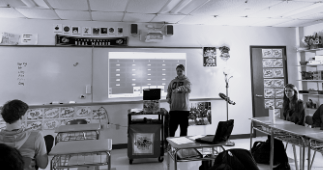
I walked into the door of the sixth grade English Language Arts classroom at Oyster River Middle School (ORMS) on my first day of Peer Instructing. Fifteen tiny heads turned towards me, confused looks on their faces. Their teacher introduced me to them, telling them why I was there.
“So, you want to be a teacher?” a sixth grader asked me. Extended Learning Opportunities (ELOs) are a place to seize an opportunity. If a student is interested in a subject that the school does not offer as a course, they can create their own experience based on that interest. ELOs are versatile, meaning that a student can turn nearly anything they want to study into a class, and they will receive credit if they fulfill their requirements.
Sean Peschel, the ELO coordinator at Oyster River High School (ORHS), defines the program as a way that students can “individualize, personalize and customize” their high school experience, through various options or categories. Whether it is creating a new class entirely, serving as a Peer Instructor, beginning an internship, or participating in an advanced study, students are in control of their experience.
When participating in this program, students will meet with Peschel, who will help them understand the guidelines and what is required of them to meet the ELO program’s criteria. I created my ELOs with the help of Peschel and my counselor, where Peschel approved my self-created competencies, and helped me find a time in my school day that worked for me and the teachers I wanted to work with.
Typically, the counseling department does a great job of presenting all of the options for classes and opportunities that students at ORHS have at the assemblies at the beginning of each school year. Although not many people know about the ELO program, I think it is valuable to learn more about, because of how much this program has helped me. I have done two ELOs myself, one where I helped teach a Spanish 4 class at ORHS, and one where I travelled to ORMS and taught 6th and 8th graders in English Language Arts classes. This program has allowed me to create my own experiences, tailored to my own personal goals.
“ELOs are a great chance for the students’ voice to be heard. They’re the ones that are in the driver’s seat,” says Peschel.
Leslie Ayers, a Spanish teacher who had a student who Peer Instructed in her class last year says, “anything can be an ELO, so if there is an interest that doesn’t necessarily have an academic tie in the building, take advantage of it. Because you may find something that you absolutely love that you never would have had a chance to do.”
Lucky Muppala (’26) had her ELO at Frisbie Memorial Hospital, in Rochester NH. She observed rehabilitation areas, such as occupational and physical therapy, and cardiology. On her experience, she said, “[ELOs are] a great way to experience something new, especially because in high school you’re just doing one thing or the other, and this is a great way to get out into the field, experience something, and get to know if this [area of interest] is something you want to pursue.”
These experiences grant students the ability to observe and be in a field they have potential interest in, and they help determine whether or not that field works for them.
Georgia Leone (’28), is interested in diplomacy, and for her ELO, she arranged meetings with a few former diplomats and asked them questions about their experiences. She said, “I feel like I have more of a clear direction of where I want to go after high school now.” I agree with Leone, as my experience helped me figure out what subject I was interested in, and if teaching really was the area for me. I’ve heard several stories while talking with people who have done ELOs, and they have helped them confirm their interest or disinterest in a topic. Ayers says, “I think ELOs are huge. I think it’s important for every kid to investigate something that might interest them, even if it ends up that you absolutely hate the topic.”
These possibilities can make school seem more inviting or interesting to people who may not feel like there is a class for them.
“That’s where students who aren’t engaged in school become engaged in school,” Peschel says, about students who have completed ELOs.
Students interested in the ELO program should reach out to Mr. Peschel with questions.
Although I am graduating soon, I hope that those sixth graders I helped teach will be able to use this program when they come up to ORHS. While it may not be Peer Instructing Spanish and English Language Arts classes like me, there are so many directions the ELO program can take people.
-Riley Duggan



 Mouth of the River
Leave a Reply