
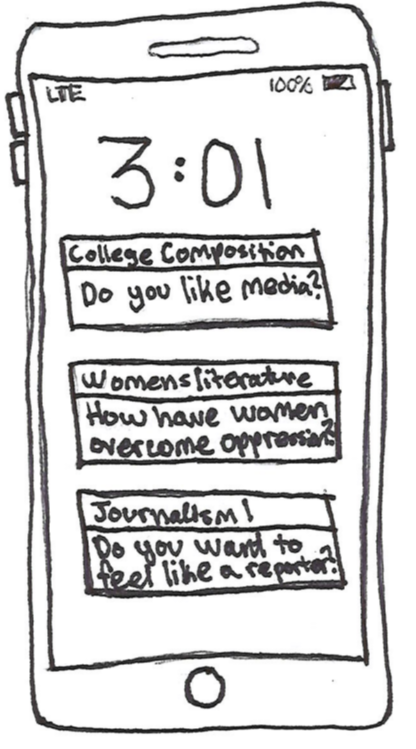
Looking at the program of studies my freshman year immediately had me overwhelmed. I was suddenly wishing I had an upperclassman friend to tell me what each class really entails, not just the course description. Because underclassman are having most of the English classes open up to them, I wanted to become that upperclassman I once dreamed of and offer advice. There’s been others done by Mouth of the River (MOR) staff, like an AP guide by James Li, and a general course guide by Paige Stehle. However, not one is just English specific. This led to me talking to five students who have taken English classes besides the ones that were required for them and getting their thoughts on the course. While there’s 31 English classes at Oyster River High School (ORHS), I only cover five in this article, so keep in mind you aren’t limited to just these picks!
Caroline Desantis (‘27) decided to take Critical Analysis of Storytelling. This class counts towards a communications credit, and is centered around watching films and deciphering the deeper meaning of them. Desantis described how with each movie, there’s a formative and summative assessment on it. The class focuses on group discussions of the films, which can also be graded. Desantis advises that you’re able to think critically and be able to communicate your ideas strongly. While there’s rumors of the class being “easy” and “free” just because you watch movies, Desantis emphasizes how there is work outside of class and effort to be put in, even if you are watching interesting films for some of the class. She says that now she can notice motifs and films when watching movies and shows outside of class now. “When I was watching Get Out, I immediately noticed things like the deer, and knew it was the director using a motif.” After critical analysis, you’ll be able to apply your new knowledge to anything you watch.
I then talked to Andy Piper (‘26) about the Women’s Literature class he took. The content of the class is, as the name gives away, about women and the struggles they’ve faced and how they’re represented in media. It covers multiple decades, including the objectification of women in the Victorian era, as Piper described how women were viewed as subhuman then, and their mental health struggles weren’t taken seriously. He also talked about how the class had a unit on the fight for the equal rights amendment, which helped to unify women of all races and class. “I hope whoever takes this class has an open mind going into it,” Piper suggests. He also said that the class uses presentational and discussional skills, and he emphasized being able to apply the knowledge you learn into your real life about women’s struggles. When asked who he would recommend the class to, he said, “I really want men to take women’s literature… I think that a lot of men would benefit from knowing how women have struggled.”
Next, is College Composition. This class isn’t too far from Critical Analysis, but you aren’t actively consuming the media you’re writing about during the period. Carter Peterman (‘27) took this class last semester, and I was interested about his experience and perspective, as I was in the same class as him and wanted a different view on it. He said he’d recommend being open to becoming a stronger writer, as the class helped strengthen his abilities with the essays you have to complete. “Be able to have your own voice when writing and be able to come up with strong theses and claims,” he suggests. It’s also important to be willing to analyze the information you end up researching. Social media topics are often brought up in class, and Peterman reflected on how interesting it was to learn more in depth about how platforms work and can influence us. College Composition can also count as college credit through Great Bay Community College, so you can strengthen your writing abilities while also earning extra points towards college.
Journalism 1 was also a popular pick for English electives, which many sophomores have found themselves taking. Payton Drapeau (‘28) was one of these sophomores, and she ended up enjoying the class immensely. She said, “[journalism] kind of opened me up… [by] being able to talk to new people and getting all of my interviews.” Drapeau recounted how you don’t have to necessarily be good at interviews, because journalism helps you to prepare for doing them. It also preps you for being able to write in multiple styles, but she notes how you need to be able to meet deadlines. If you can’t, some people can fall behind with their drafts and interviews. However, she talked about how journalism can teach you to not procrastinate, as she went into the class as one but was able to meet all her deadlines. In Journalism, you can also write about whatever you’d like to, which is similar to more of the advanced English classes. By completing Journalism 1, you can also choose to go into Journalism 2 (Mouth of the River!) after.
Finally, I talked to Katelyn Mitchell (‘27) about her Fiction Writing class. “Fiction Writing helped me to put my thoughts onto the page in a timely fashion,” she said. Mitchell says the class has a lot of creative freedom, as most of the time you get to choose what specifically you’d like to write about. Similarly to Critical Analysis of Storytelling, there’s a lot of sharing what you’ve made in groups, so Mitchell recommends that you’re able to feel comfortable doing that. “As long as you can work in class, there’s not a huge load of homework,” she detailed.
With these suggestions, I’m hoping they’ll help to aid you in your English decisions next year, which are due March 1st! Keep in mind there are many more choices than just the ones mentioned here in case none of them piqued your interest. If there’s other classes you’re interested in, and you’re having no luck with the course descriptions like I did, I’d recommend asking teachers and other upperclassmen. Most will be more than ready to give you suggestions, and for students in particular, the honest truth.
– Emily Taylor



 Mouth of the River
Leave a Reply