
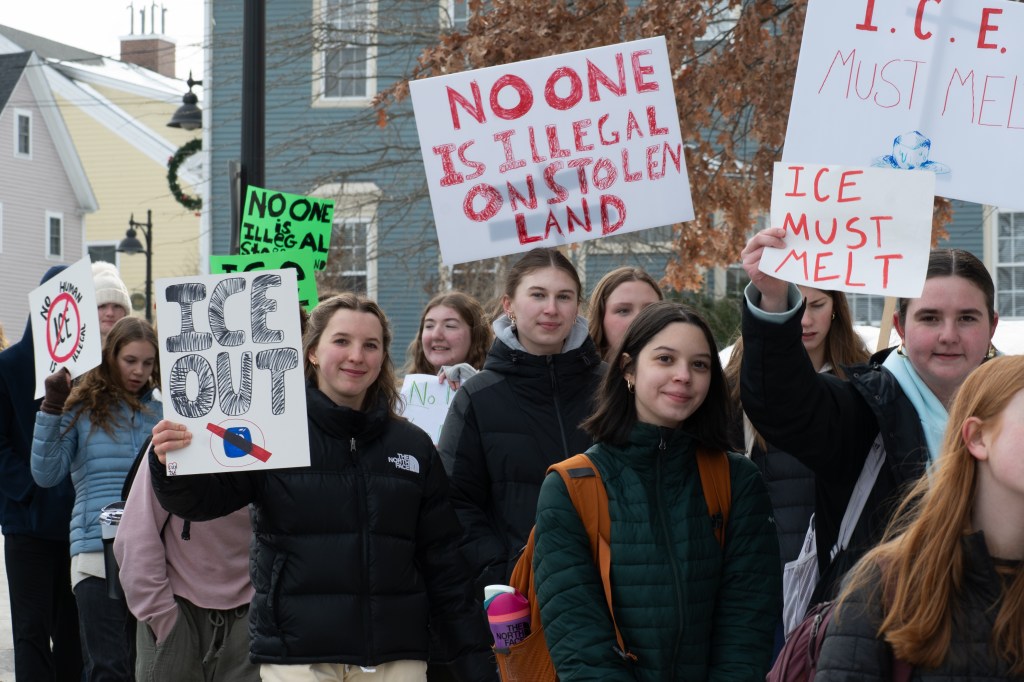
As the clock struck noon on February 6th 2026, hundreds of students filed out of their classes and into the Oyster River High School (ORHS) courtyard. This walkout was a result of a student-led protest against the increased presence of Immigration & Customs Enforcement (ICE) officers in communities across the country, including Minneapolis, Minnesota. This protest was one of hundreds happening across the United States of America in recent weeks, emphasizing one of the most pressing and controversial issues currently sweeping across the country as the U.S. struggles to balance citizen security, human rights and immigration reform under a new administration.
In Durham, New Hampshire (NH), a town nearly as far north as possible from the southern border, it’s easy to feel far removed from these types of issues. However, these national scale topics often extend far beyond what we see on social media and the echo chambers in which we live. If ORHS’s recent display of student activism shows one thing, it’s that people are being affected right here in our community whether we realize it or not.
A New Administration
On January 5th 2025, President Donald Trump was sworn into office for the second time. One of his first presidential actions in his second term was the issuing of the first of several executive orders regarding immigration, titled “Protecting the American People Against Invasion.” This 23-section order outlines the strict crackdown on immigrant rights and funding for the removal of undocumented immigrants in the United States. This includes the revocation of all immigration laws instated under the Biden administration, and the abolishment of sanctuary jurisdictions.
A year later, on the morning of January 7th 2026 — nearly a month prior to the ORHS walkout — 37-year-old Minneapolis resident Renee Good was shot and killed by an ICE agent, just blocks from her home. Described by friends and family as a mother, wife and poet, Good’s untimely death is reported by President Trump’s administration as an act of self-defense, although this narrative is disputed by local officials according to the Associated Press story, “What to know about the fatal shooting of a woman by an ICE officer in Minneapolis.”
As the aforementioned article states, this is the fifth such casualty resulting from the aggressive U.S immigration crackdown enforced by the Trump administration starting in 2025 and since it was published, there have been eight more ICE related deaths in 2026 on top of the 32 from 2025.
“[ICE is] governed by the Department of Homeland Security (DHS). So, in their viewpoint, they’re getting rid of people that shouldn’t be here anyways. [Undocumented immigrants] are breaking the law according to the [DHS],” says Sergeant Mike Nicolosi, ORHS’s school resources officer and member of the Durham Police Department. However, Nicolosi argues that the methods ICE has been using to capture and detain individuals are stepping beyond their responsibilities stated by current legislation. “We need to have laws. If there are no guidelines, there’s chaos. But I think there’s a way to go about [carrying out those guidelines] — it needs to be lawful and it needs to be legal.”
Our Immigrant Neighbors
Since the country’s very founding, immigration has been the lifeblood of America. Many industries rely heavily on immigrant labor and “the melting pot nation” — a diverse mix of culture and history — would be simply unattainable without the influx of foreigners. Furthermore, the country itself is entirely built upon immigration – all the way back to when the first colonists set foot on what would later be American soil. However, now more than in recent years, the future for immigrants and their families is uncertain and fear runs rampant in immigrant communities nationwide.
“It’s a very unique country because a lot of people come from all over the world and become citizens,” says Itchiko Harju, a paraeducator at ORHS. “When we say we are American, we are saying we are [in some way connected to] an immigrant.”
Born and raised in Japan, Harju moved to the United States following her marriage to an American citizen. Harju remembers her initial fascination with the country, viewing it as a fantasy-like place of great diversity and freedom throughout her childhood. However, for immigrants, many of those freedoms are now at jeopardy.
“For me, I grew up with a bunch of immigrants. I grew up near Lawrence, Massachusetts, [which is] 75% Hispanic,” says Nicolosi. “Now, that place is a ghost town. There’s not a lot of people walking around because they’re afraid they’re going to get picked up and taken away.”
Under new immigration policies, it is becoming increasingly difficult for immigrants and refugees to obtain legal status and citizenship in the U.S.
“A lot of people I’ve worked with in my previous jobs were [immigrants]. They weren’t here legally, but to watch them go through that process of fighting really hard to stay here. And they were paying taxes. They weren’t working under the table and were still contributing to society there. These people were working three, four jobs, just trying to make a better life for their family,” says Nicolosi.
Saarika Arthanat (‘26) echoes these statements. “A lot of people have the misconception that all illegal immigrants are violent,” she says. “The reality is that most immigrants are just trying to live an honest life and have better opportunities for themselves and their family.”
Arthanat is second-generation immigrant from India. While she was granted automatic citizenship at birth, her parents came to the States on an H-1B visa – a nonimmigrant work visa that allows companies to hire foreign workers. These workers can later attain citizenship through naturalization, a process in which immigrants apply for citizenship after a certain number of years of residency. According to the U.S. Citizen and Immigration Services website, drastic measures have been taken since to reform the H-1B visa program with President Trump’s signing of the “Restriction on Entry of Certain Nonimmigrant Workers” proclamation on September 19th, 2025.
As Harju highlights, while the immigration crackdown is designed to control the population of undocumented immigrants in the country, it is also significantly limiting opportunities for immigrants to enter the country legally. This not only limits work opportunities for immigrants seeking asylum from their home countries but also makes the process of family reunification far lengthier and more difficult. “Many people who are waiting to come to the United States are waiting for up to 20 years. They’re waiting in line to be with their family,” says Harju.
The Local Picture
Despite a smaller ICE presence and far less national news coverage, these issues are still very prevalent in the state of New Hampshire and even the ORHS community.
Heather Totty, Deputy Director of Philanthropy of the American Civil Liberty Union of NH, describes the organization’s relatively recent involvement with the topic of immigration starting in 2018 under the first Trump Administration. “There were a large number of people being detained in the Strafford County jail and the reason that federal immigration enforcement authorities were using that facility had a large part to do with the fact that there was no legal infrastructure in New Hampshire to support immigrants,” she says.
This is largely due to the fact that the population of immigrants in New Hampshire is quite small compared to the rest of the country. However, as Totty states, this does not diminish their presence in the state or eliminate the need for legal protection.
Arthanat says, “It can be difficult to navigate being an immigrant in such a homogenous community.” However, while a minority, she is far from alone. Arthanat explains that several of her friends share the same struggle, with many of them also being children of immigrants. She notes that fear has become an increasing trend in her friend group, with some choosing not to participate in the ORHS walkout not because they didn’t want to, but because they feared for their own safety or that of their families.
“I’m more scared for my parents,” states Victoria Zlotosch (‘27). As a second-generation immigrant, Zlotosch also shares that the current tensions in the United States are making it more difficult to accept and celebrate her Polish roots. “Right now, it can be a struggle to appreciate my culture,” she says.
Beyond the walls of ORHS, the crackdown is affecting people and communities across the entire state. A major recent update for the state of New Hampshire is the decision to halt forward progress in the plan to build an ICE detention center in Merrimack, NH – less than an hour drive from Durham. Governor Kelly Ayotte’s announcement has concluded a two month long local debate according to WMUR’s news brief titled “Plan for ICE Detention Center in Merrimack has Been Scrapped, Governor Says.”
This decision has been met with mixed reactions from local residents. While many view this as a win for Merrimack and the state of New Hampshire, others criticize Ayotte’s methods or argue for the detention center’s necessity to contribute to the objective of recent legislation.
While this culmination concludes an important chapter of New Hampshire’s involvement in the larger national picture of immigration rights, conversations between NH residents and lawmakers are far from over as New Hampshire continues to fight to maintain its self-governance.
Students Take Action
The ORHS walkout on February 6th was organized by a diverse array of passionate students. Among them was senior class president Deems Brant (‘26). Due to the overwhelming demand for action from ORHS students, Brant worked with other student leaders to plan the event and ensure everyone had an opportunity to let their voice be heard.
“It isn’t about projecting my own opinions, it’s about giving the opportunity to students who are passionate,” he says.
While the walkout was not condoned by administration at ORHS, it was a demonstration of the first amendment rights students have as American citizens. Many students left their classes to protest the violence and intense political tensions currently present in the country, at the expense of their own education.
Nicolosi says, “It’s gotten to this point where there is so much disassociation with groups in the United States. It breaks my heart because I don’t feel like we’re as united as we used to be. I’m hoping that there’ll be a time when we all become united again and work together and look at issues from different perspectives, but I think we still have a long way to go.”
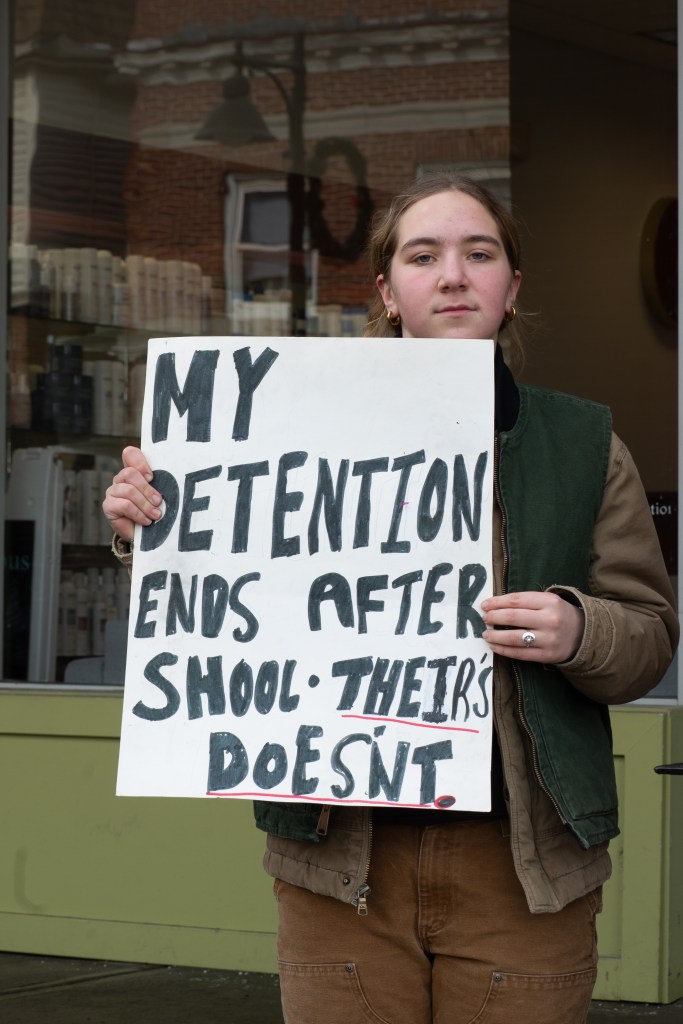
To quote Brant in his opening speech: “If people are ever to reach their full potential, we must have tolerance for differing views, and the courage to look beyond the labels that are so easily thrown around. Behind every label is a human being with ideas, fears, and experiences worth understanding.
We cannot live on small islands in congregation with only those in assent with ourselves. Recent events have shown that when voices are silenced, when dialogue disappears, violence fills the space left behind… this is not the world we want to inherit or create.
– Jahrie Houle
Image courtesy of Elise Bacon

 Mouth of the River
Leave a Reply