
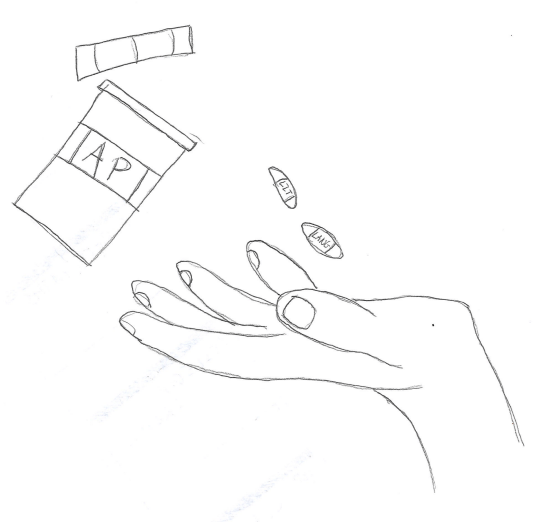
Recently, the new Superintendent Dr. Robert Shaps made the decision to institute two sections of AP Language and Composition in the 2026-27 school year. This decision was met with mixed reactions from the English Department.
The Oyster River High School (ORHS) English Department has backed an electives system style curriculum for several years, consistently refusing to integrate English APs, despite ORHS’s significant inclusion of many Math and Science AP classes.
The question of having an Advanced Placement (AP) English has been brought up frequently over the years at ORHS. It seems that ORHS is one of very few schools that refuses to add any AP English courses to the curriculum. This has been noted to be a highly unusual stance by many, especially for a school like ORHS that takes pride in its academic standing.
The reason why ORHS has seemed to be so stagnant in its inclusion of English APs is often speculated by both parents and students. The real reason is a little more complex, involving both student motivation and an attempt to preserve a passion-lead electives system.
Trevor Garman, Chair of the English Department and longtime English teacher at ORHS explains, “We have pushed for many years for students to develop intrinsic motivation… students are motivated to do something because that thing is good in and of itself.” Garman’s stance on the topic involves concern that the inclusion of APs will put external pressure onto high-achieving students to take the AP course for the credits. A curriculum without classes with a credit attached would enable students to take classes they’re more passionate about.
“We promote courses where students want to excel because they believe in what the courses promote,” Garman continues. It’s projected for two sections of AP Language and Composition to run next year. AP classes are yearlong sections; this means that four sections of English electives will not be taught next year. Many teachers in the English department are questioning whether this trade-off is worth it, as it somewhat derails the electives system.
This decision has the potential to deconstruct it even further if even more AP sections are included. “It could possibly reduce student choice,” comments Garman. So far it seems like the Advanced Seminar and Advanced Writing classes may be on the chopping block.
This development of the English curriculum also raises the question of more changes made to other English classes, such as the mandatory underclassmen courses. As of now, all underclassmen take the same level of English classes as Freshmen and Sophomores. This is a heterogenous class model, the idea that students of all levels should be kept together. “Tracking systems divide students into perceived ability levels. Sometimes that is valid, but often it is not,” states Garman.
Tracking systems are common and encouraged in math and science courses; they’re instituted here at ORHS, specifically in the math courses. For ORHS students in the first three years of high school, they’re placed into a pathway of classes based on skill levels from middle school. This pathway opens to a selection of electives in their senior year, some more accessible based on prior classes.
However, English is much more versatile and subjective. When it comes to English classes the idea is that keeping students on the same track from the time that they’re in the eighth grade until they graduate makes them miss out on being met with challenging material or finding a skill they didn’t know they had.
Shaps comments “I certainly am a strong supporter of this idea of heterogeneity, as opposed to what is typical in other schools where there is leveling.” Although Shaps was a supporter this model of classes, he stood firm on his decision for upperclassmen APs.
Shaps brought up his history as the Superintendent at Mamaroneck School Districts in New York State. During his 13 years there he also instituted AP classes in schools that previously did not have them. “After I first included APs, every year the population and pass rate of these classes grew. It was important for me to provide these opportunities for college credit, as we had a large population of underprivileged students, students that struggled financially, first-generation immigrants, and first-generation graduates.” States Shaps.
On the other hand, the utility of taking an AP class can be extremely helpful for students, potentially saving them thousands of dollars. When a person enrolls in an AP course, they have the opportunity at the beginning of the year to register to take the test. AP tests are scored out of five and depending on what college the person is attending and what score they got on the exam. Taking and passing an AP can allow a student to skip certain classes. This means that a college student saves money by graduating early or not having to pay for a class.
With the expenses of colleges rising every year, higher levels of education are becoming further out of reach for low-income families. According to College Tuition Compare, the average in-state tuition for a New Hampshire college is $14,435 per year, before any type of financial aid.
However, one of the points of dissent brought up was that certain English electives already offered had the course work to prepare a student for an AP test. Shauna Horsely, ORHS English teacher states, “We encourage students to take the AP exams after certain electives… it’s worked pretty well in the past,” she continues later “That is not to say that AP isn’t a good course… but we offer similar skill development in our other courses.” It was a common feeling in the English Department that it would have been preferred to augment certain pre-existing courses to include more AP material, as opposed to including a new class.
This idea of a compromise between AP classes by changing certain curriculum to gear towards student interested in taking an AP English test was discussed last year. In a Mouth of the River (MOR) article titled “A Revised English Curriculum,” Garman explored the heterogeneity model more deeply, and comments on its importance.
ORHS has always offered any of the English AP tests, and usually there are a few select students every year that prepare for the test independently or collaborate with a teacher to study. Horsely comments, ‘I don’t think [AP English is] more rigorous, it’s prescribed.”
Elena Pavlik (‘25) took the AP Literature and Composition test her senior year, studying for it independently, and comments, “Last year I took Advanced Writing and Advanced Seminar-which I loved- but I really wanted to have that AP credit because I knew a lot of the schools I was applying to would take it.” Pavlik goes on to describe how she had no concept of how the model of the AP test would work but became informed through study guides and online resources. She continues, “I really enjoyed Advanced Writing and Advanced Seminar, and I probably would have enjoyed an AP, but I ended up not needing to take the classes to do well on the test.”
Data from ORHS counseling shows that from 2020-2025, 17 students have taken the AP Language and Composition AP test, with an average score of four, the lowest being two. Along with these, 10 students have taken the English Literature and Composition AP test from 2020-2025, with an average score of four as well, the lowest being three. It’s likely that the number of students taking these tests will greatly increase after the inclusion of the class next year.
Despite some dissent among the English Department, it’s been decided that the class will be included next year at the potential loss of some sections of an advanced elective. It remains to be seen if the AP Literature and Composition class will also be included, but either way these classes will cause some major changes to the English Department, and the opportunities offered to students. Garmen states “AP Language and Composition is a good class; we’ll teach it well.”
-Anne Graff



 Mouth of the River
Leave a Reply