
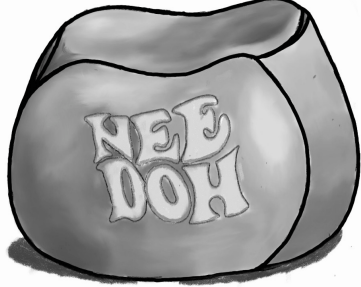
Life is built to be stressful; work, family, friends, and don’t even get me started about school. I swear only yesterday I was a freshman, and now I am going to graduate next year. Every day I feel more stressed. I have colleges swarming with emails and mail, math tests that don’t make any sense, the SAT to start studying for, essays due where every sentence sounds clunky, and classes to pick for next year. I thought that I was doomed, every path I took being filled with stress. That was until these tiny colorful cubes started to appear in my friends’ hands, then in other classes, and now in mine. What I once saw as a stupid toy, became an Oyster River High School (ORHS) sensation. Many colors, shapes, and textures but only one name: NeeDoh.
I often hear stress toys dismissed as childish distractions; something to fidget with during class or toss aside as a trend. I have heard that stress toys, like NeeDohs, serve a purpose beyond novelty. In a world where anxiety is rising among students and adults alike, these small, squishy objects are supposed to offer a simple, accessible way for us to manage stress and improve focus. For many students, having something to squeeze can ground the body and calm the mind.
As each one of my friends got a new NeeDoh, my curiosity grew. The small, purple, blue, and pink cubes would be passed around during flex; sometimes you would even see them flying through the air. As time went on, I wanted one more and more. I would see them being squished in nearly all of my classes and being the popular topic of conversation. “I have noticed that kids will have them during tests; some teachers have bins of them on their desks,” said Celeste Best, ORHS science teacher.
I never saw the hype about NeeDohs. I thought they were just propaganda put out by a company, stating that they reduced stress and calmed the mind. I said that I would never buy one, but Christmas came early, and I was gifted three: two NeeDoh cubes, and one purple diamond filled with water. I didn’t realize how important they would become until midterms were around the corner.
Stress affects focus, mood, and even physical health. For students especially, pressure from exams, teachers, parents and even social media can feel overwhelming. Playing with fidget toys, like NeeDohs, can open certain parts of the brain, like the prefrontal cortex. This area is connected to neural pathways responsible for motivation, impulse control, emotional processing, and focus. When someone squeezes a stress ball, the sensory receptors in the hands are triggered, helping redirect anxious energy and improve alertness and blood flow, according to a paper published by Hubei Institute of Fine Arts called “The Rise of Sensory Fidget Toys: Origins, Psychological Principles, and Their Role in Stress Relief and Mental Health.”
I have often seen these stress relievers in my math and science classes, anytime we need to focus and especially during tests. Lucy Milutinovich (‘27) said, “every test I have taken this year, I have had a NeeDoh by my side, doesn’t matter shape or size, it’s there.” Addie Dillon (’27) adds, “it helps me to focus, especially when I’m doing my homework, or I’m studying for tests. It gives my hands something to do while my brain is thinking.”
Sometimes, especially in math class, I often find myself looking around the room or at the ceiling when I am stuck on a question. I look at other students in the hope that the lightbulb above my head finally goes off. Luckily, I have my NeeDoh by my side to calm me down, but there is also another purpose. When stuck on a question, squeezing the NeeDoh can help clear the mental fog.
An article posted by HinesLead, “Anxiety Relief Fidget Toys: How They Work on the Brain,” quotes research from the UC Davis MIND Institute (2024) that shows that fidget gadgets during stressful situations can reduce intrusive thoughts by about 32%. Also taken from the article, similar studies from the University of Illinois suggest that brief sensory stimulation helps refresh mental focus without disrupting attention.
“I do notice in class, you’ll see someone staring at a question that they’re stuck on, and you can see the stress, and then anything in your brain becomes that much harder to access. So, they’ll stop and play for a minute…It’s like that calibration of, hey, it’s going to be okay,” says Best. Even if you are able to unclog the brain, many students jump to the conclusion that they will fail. Fortunately, it has been proven by the National Library of Medicine in an article, “Impact of fidget devices on anxiety and physiological responses in adults with ADHD” that stress toys also support cognitive redirection by shifting attention away from negative thoughts and promoting more positive, task-focused thinking.
Stress isn’t just found in the classroom but also on the court, or field. For Audrey Gompert (’28), a club volleyball player, she mentions the stress she feels during her games. She says, “sometimes I start to spiral when my team is down or we keep making mistakes.” Gompert isn’t the only athlete that struggles with stress, in fact 91% of high school students report experiencing some level of stress related to sports, according to ISNation, a mental fitness website.
After the first day of her tournament, she went to CVS with her teammate Elizabeth Piller (’28). There she found a four-inch cheese squish ball: Squeezy Cheese. Gompert purchased it for her team. The next day, while they were playing, the cheese sat on the bench. When players came off the court, or before subbing in, they would squeeze the cheese to release the stress. Gompert says, “I felt that I was channeling my negative energy into the cheese…It’s a coping mechanism to get my brain to think about something else rather than what is happening in front of me.”
There is always the argument that even though these toys do help one to focus, it might distract everyone else around them. Best says, “I haven’t found an issue with these types of stress toys, but I used to have to say if it’s going to light up, flash and make noise, we need to find a different option.” Especially with the 2016 fidget spinner, or the 2020 pop-its, the sound of these fidgets are often more distracting than stress relieving. Luckily, most NeeDohs are silent, allowing for a distraction free environment.
A quote taken from the NeeDoh website states that “NEEDOH toys provide a perfect balance of play and relaxation, helping to relieve stress through soothing, squeezable fun.” I can say that this is true. Since I was gifted the NeeDohs, I have taken them with me when I know I will be in a stressful situation. I like to have my NeeDohs with me when studying or during a test. Even if I don’t use them, their presence calms me as I know that they are something I can use to stop the mental fog. I have also taken them on the plane, or to doctors’ appointments to hopefully calm my nerves a little. While I am not doing anything stressful and I am just waiting for something to happen, I like to play with my NeeDoh and focus my mind on something else.
Originally, I thought that these cubes were just toys. Then I got invested and thought I fell into the propaganda trap. Then I started to love them. I started to notice small benefits to them; helping me to focus and retain information better or calming me during a test. I wanted to see if these benefits were actually real, or if it was just the placebo effect. After writing this article, I can conclude that stress toys really do positively impact high school students; whether it’s with help fighting stress, or focusing in class.
So, if you are looking for something to help you refocus or fight those bad thoughts then I recommend getting a NeeDoh. A NeeDoh isn’t just a toy but a weapon to combat stress. Milutinovich says, “anytime I need to focus, I need a NeeDoh.
-Thea Smith




Leave a Reply