
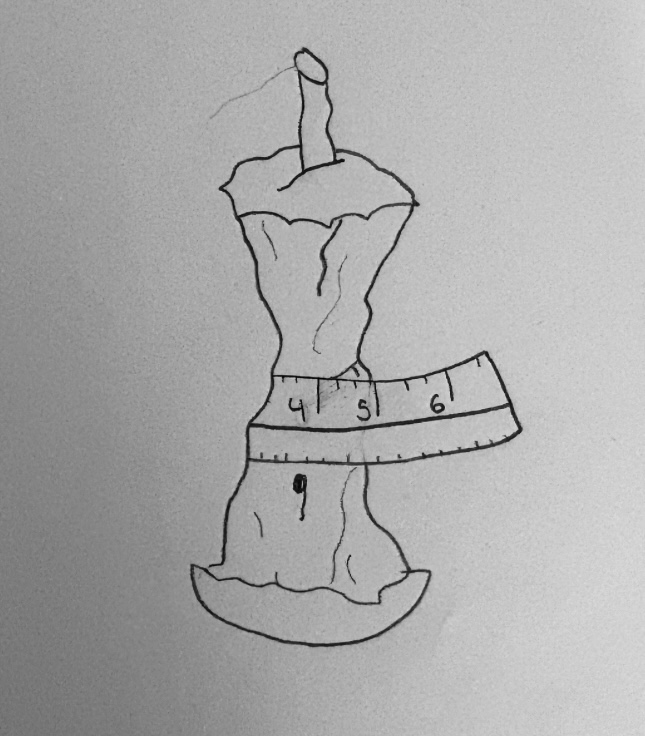
Shrinking bodies, weight loss, and starvation are all images the phrase ‘eating disorder’ tends to evoke. When the term is mentioned, people picture fragility, visible illness and almost certainly never the most dedicated weightlifters at Oyster River High School (ORHS).
In recent years, social media has advertised an idea of what ‘healthy’ looks like. Rarely is this idea accurate, and often wrongly depicts attainable habits, goals and bodies. Simultaneously, it has caused a rise in disordered behavior involving eating and exercise among teens everywhere.
Orthorexia Nervosa describes obsessive behavior with eating ‘clean’ foods. This fixation with only consuming things that are deemed ‘pure’ lead to harsh restrictions and dieting. The disorder is characterized with ritualized eating, ingredient obsession and perfectionism. Unlike Anorexia Nervosa, which primarily focuses on food quantity, Orthorexia fixates on food quality.
The eating patterns usually works in tandem with regular exercise and more often than not, weightlifting.
For decades, the idea of ‘discipline’ in pop culture has dominantly been associated with thinness. The growing popularity and use of social media made the image of emaciation easily available and even trendy online. Today, that specific image is being replaced, but not by anything healthier.
Today the message is no longer eating less, it’s about eating right.
This mindset is present in gym culture even among students. Often individuals involved in fitness build specific intake goals of certain macronutrients. Gym regular, Finn Rice (’26) described structuring his eating routines around calculated numbers. Every day he eats 150 grams of protein and around 3,000 calories. These checkpoints are not random; they are deliberate and based on Rice’s activity level.
While he doesn’t track every single calorie, the numbers still guide his meals. Aiming to stay around 10-13 percent body fat, Rice has his diet down to a science he practices religiously.
To ensure these goals get hit, continuous planning is required. I talked with senior T to understand how the process worked. “I usually sit down on Saturdays to collect recipes I want to make,” T explained, “Then Sunday I go to the grocery store and get everything I need and make everything I need for the week.”
Each meal is measured “I weigh everything out,” T said, “it’s usually 8 ounces of chicken, 8 ounces of rice.”
When they’re not eating a planned meal, T is scanning nutritional labels. “I won’t eat something if the amount of calories or the ingredients don’t fit into my plan.”
Hidden by a facade of lifting heavy weights and a high protein intake that might make orthorexia appear to be a healthier alternative, the habits are still built upon the same fear of food adjacent to more common eating disorders like anorexia.
Often times the motive to track calories and plan meals are to lose weight. “I was eating 2,500 calories a day and the scale wasn’t moving,” T said, “So I tried 2,200, and it did.”
The media plays the largest role in the promotion of orthorexia. Algorithm driven platforms like TikTok and Instagram, like society, push out and reward aesthetically pleasing content. Formed videos describing ‘What I Eat in a Day’, or weight loss journeys can be advertised because of their perfect packaging and trending song choice. These posts never show constant thoughts about health, only the visually appealing summaries.
What’s so dangerous about the promotion of orthorexia in the media is that it’s difficult to detect it at all. The language around the eating disorder has been translated into messages that come across softer.
Instead of terms like ‘starving’ and ‘dieting’, influencers use vocabulary like ‘fueling your body’, ‘wellness’ and ‘meal-prep’. A video a fitness influencer creates that depicts unrealistic eating habits and excessive exercise can easily pass as a person prioritizing their health and keeping ‘balance’ in their life.
Social media consistently presents a curated type of control that can appear desirable and deceptively attainable to their consumers.
What’s changed the most about disordered eating in recent years is not pressure, but presentation. Common ideas have shifted from the need to be thin, to the need to be healthy. Yet ‘healthy’ today can be completely the opposite.
I sat down with senior A to get more insight. They explained how their eating habits were fluid through different disorders during high school. To A, orthorexia became a gateway into other issues, like anorexia. It’s easy to transition from one into the other due to similarity in obsessive behavior around food intake and exercise.
Additionally, goals in physique may shift from building muscle to toning down. In an attempt to achieve this, people often find themself in extreme calorie deficits or complete starvation.
“There was a point where I was eating close to 1,000 calories daily,” A recalled, “And if I ate more than that I felt like I had ruined my day.”
Most people are not aware that orthorexic behavior represents an eating disorder. “I thought I was doing everything right by getting leaner,” A said, “But leaner to me meant skinner, which meant weaker.”
The physical aspects of the disorder, like exercise and whole-food diet, aren’t necessarily the unhealthy part; the obsessive behavior is.
“It was so stressful,” A continued “instead of enjoying time with my family, I was constantly thinking about what I was eating, what was in it, how many calories it had.”
In some cases, the pursuit of dietary perfection extends past food and exercise. Rice admitted spending hours a day researching nutrition on PubMed, a website dedicated to biomedical literature.
It doesn’t stop at research. Rice also described using injectable peptides to supplement progress. “I was taking two different ones, one for skin health and one that stimulates growth hormones,” said Rice. “It might help you put on a little bit of muscle too.”
Gavin Walsh (‘26) also rejected the idea that this mindset could be classified as disordered. “I think it’s kind of bullsh*t,” he stated, “I don’t think it’s a bad thing to eat a lot of chicken, do cardio and track your macros.” To Walsh, the strict routines he followed, and constant optimization are not warning signs, but steps that should be rewarded.
He isn’t alone in this stance. Many people don’t see the issue in a want to ‘be healthier’, or even see it as something more people should participate in. Walsh concluded, “Sorry I’m going to be eighty and jacked.”
Going to the gym and caring about the quality of food going into your body doesn’t automatically mean you are affected by orthorexia. Like most things, it’s a spectrum.
Prioritizing health, in truth, can rarely be a bad thing. However, it heavily depends on your definition of what health is.
After hundreds of thousands of people have lost their lives to anorexia, and millions more affected, rebuttal towards the disorder only began gaining significant traction in recent decades. Orthorexia is already on the same path, as it affects more people every day.
Eating culture has been evolving for years and it’s not uncommon for trends to pop up in society. Somewhere along the way eating well turned into eating perfection. As it turns out, perfection is never a healthy option.
If you or someone you know is struggling contact 866-903-3787.
-Elsa Svenson






Leave a Reply