
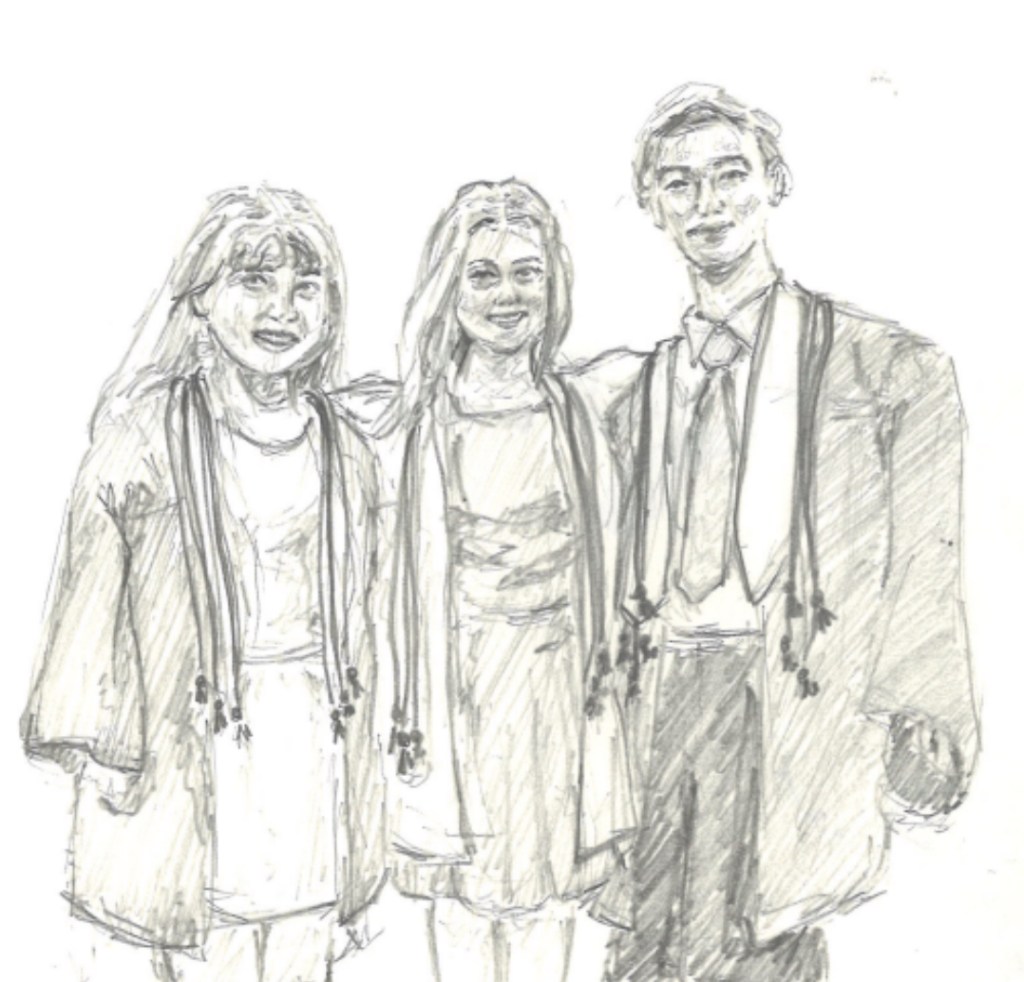
Ever since I started middle school, I remember seeing the senior class at Oyster River High School (ORHS) walking through the halls during their Senior Walk to showcase their caps and gowns, and something that catches everyone’s eye: their cords.
Green cords, red cords, blue cords, you pick a color, there’s a cord for it.
Graduation cords are not a new thing. Cords are often given out by organizations ranging from school-level to international-level, such as honor societies and clubs, to signify your participation and contribution to them.
If you’ve ever been left wondering how to get all of these cords, I now bring you Cord Collecting. This is your very own guide to the experiences and organizations behind the graduation cords you see atop the gowns of the seniors, and how to aim for entrance into these organizations.
Section 1: School and Activity Provided Cords
The ten students with the highest-grade point average (GPA) of each graduating class get a blue and white cord upon graduation. These students do not know they are going to receive the cord until the top ten students in their graduating class are announced. This cord means this student has received high grades throughout their years in high school, and this often takes a lot of effort! Shoot for the stars, and you might find yourself here.
Career Technical Education (CTE) students receive a cord after completing two years of their program, according to biomedical CTE Student Dawen Zhou (‘26).
CTE is a program where students can explore fields of work such as cosmetology, autobody, biochemistry, and many more.
On cord collecting, Zhou says, “if you really enjoy [the subject] it’s not going to feel like work. At first, I wasn’t aware that I got a cord, but it’s a bonus that I do. I chose this because I was interested in the class.”
The CTE cord is the colors of the three schools ORHS students can participate in CTEs at: Dover High School (green), Spaulding High School in Rochester (red), and Somersworth High School (blue).
Related to CTE, National Technical Honor Society (NTHS), which has a purple cord, is for students who performed well in their CTEs.
Neely Roy (‘26), a health science CTE student at Dover, says the requirements are to have been enrolled in a CTE program for two years, maintain a strong academic performance, show leadership, and be nominated by a CTE teacher.
Students are awarded this while their second year of CTE is finishing up.
Students enrolling in the military get a stole. The recruiters’ office gives students a stole, which is a long scarf like piece of fabric worn around the neck, with the color that represents the branch of the military the student is joining.
Your recruiter presents it to you after the official enlisting ceremony, where you swear into your branch.
National Honor Society
National Honor Society (NHS) is the honor society whose name is brought up most often at ORHS.
Being a member of NHS upon graduation means students get a gold stole.
In order to be a part of NHS, students must maintain a minimum of 3.5 GPA overall and complete 30 volunteer hours per year.
NHS is committed to community service, and members participate in volunteering at many school and community events. These events include working concession stands at school sports games, helping with activities at surrounding public libraries, and manning water stands at events such as local 5Ks.
Tri-M Music Honor Society
Tri-M Music Honor Society (Tri-M) provides members with a pink cord.
This honor society is for music students who maintain an A- average in their music class. They organize open mic nights and assist with activities such as ushering and creating flower bouquets for concerts.
According to Tri-M’s website, Tri-M’s values state “A member of the Tri-M Music Honor Society is one who sets a good example, is always willing to assist those students who are striving to better themselves in the music department and always remembers that real honor brings responsibility.”
Science National Honor Society
To gain membership to Science National Honor Society (SNHS), students need a 3.5 GPA in sciences, an overall GPA of 3.0, and need to be taking an advanced science class (college credit or advanced placement).
Jessica Li (‘26), president of SNHS, says their goal is to “promote exploration in the sciences and promote learning.”
They are working on creating science-related community service projects and hope to support students interested in STEM.
Li also says, “it’s important to think about the effort it takes to be a part of these societies and reach those thresholds that give you the cords.”
Their cord is green, gold, and purple, to represent biology, physics, and chemistry.
National Art Honor Society
National Art Honor Society (NAHS) gives members a rainbow cord and provides art students with an outlet to share their love of art.
Anya Shuba (‘26), a president of NAHS, says, “we did a holiday night where we painted ornaments, decorated cookies and did fun little crafts, and we invited families. We also helped set up the Durham library art show and we were at the Chinese lunar new year festival.”
This society promotes community engagement in art and is a place where artists come together and share their ideas surrounding art projects.
Language Honor Societies
Spanish, French, and Mandarin Honor Societies are the language honor societies at ORHS.
Spanish Honor Society’s cord is gold and red like the flag of Spain, French Honor Society is red, white, and blue like the flag of France, and Mandarin Honor Society’s is purple with gold decorations.
They are for students who have been studying one or more of these three languages at a high level and receiving a 3.67 GPA in their respective language class.
“The mission of the honor society is to recognize students who excel in the learning of a world language,” says Wendy Gibson, Spanish Honor Society (SHS) advisor.
The induction ceremony for these is combined into one, with each induction happening in the languages of each class.
Computer Science Honor Society
Computer Science Honor Society (CSHS) is for students interested in the computer science field.
Their cord is light blue.
They work with AI models and learn how to use different types of code.
“We meet every week, for kids to meet with other kids who program. We work on programming, organize volunteer opportunities for computer science kids, like going to Mast Way and teaching lessons on 3D modeling to the little kids, and they’re trying to organize a hackathon,” says Oliver Philbrick, CSHS advisor.
Find Your Cord
So, it seems, there is a cord for everyone.
Whether you’re a science person, a language person, or anything in between, there’s a place for you.
If you are planning to enroll in the military, or explore different career pathways, there are opportunities there too.
Find an interest, and the cords will find you.
No matter where your interests lie, there’s somewhere for you.
-Riley Duggan




Leave a Reply