
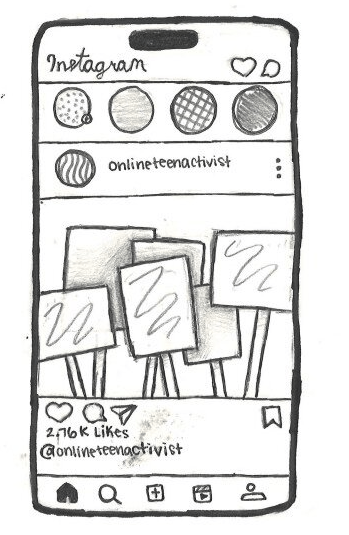
The only thing more powerful than hate is love.” “Make America Great Again.” “No one is illegal on stolen land.”
These are a few of the notable phrases that are shared by teens on social media daily, including students at Oyster River High School (ORHS). For many teenagers and young adults, reposting, commenting, and sharing things on social media is a way to take action. But why do so many teenagers decide to be activists online? The pandemic changed how teenagers participate in activism, shifting from in-person to online. In wake of this change, more students at ORHS are becoming online activists, showing a trend in youth activism.
Current teenagers spend hundreds of hours online, and many of those are spent sharing their thoughts and beliefs in relation to current events or politics. However, this type of online activity has ramped up in recent months. Online activism makes it easier for people to speak up about current events or politics, only needing to press a few buttons in order to contribute.
Current event movements can be amplified by social media in the form of hashtags and trends like #MeToo or #BlackLivesMatter. Online activism has allowed movements like these to gain more traction than what would be possible without the internet. This brings up a pro of online activism; it lowers the barrier of youth being able to participate in activism. With the ability to add a hashtag, image, post, or repost, online activism is a simpler way for students to act compared to other forms of activism.
Boston Children’s Digital Wellness Lab reports that 66% of teens believe social media helps them show their support for issues and causes that are important to them. Support is the key word in that statistic because online activism has risen in popularity for one main reason: there are many ways to show your support.
The highest level of online activism is for those who are ready to commit considerable time and effort, but also risk. This could be organizing a large-scale protest online or creating campaign websites, taking the risk of having your name solidly connected to your actions.
The middle level of online activism is typical for most involved in current events issues. Signing an online petition, donating to an organization, or writing a short post about an issue are all great middle level commitments. Websites like Change.org create great opportunities for online activism, even at ORHS, where the petition Stop the Firing of Math Lab Teacher, Miss Jeong was created for the math lab teacher Sarah Jeong in 2025.
On the lower level, anyone can give a like or repost, use a hashtag, or change their profile picture to represent their beliefs. This lower level of activism still contributes to making a change but requires less involvement if that’s what’s right for you.
Many students at ORHS fall under this category, like Ilona Wolfson (‘28) who is an avid online activist. Wolfson chooses to post or repost about politics and current events online mainly because it is important to her, but she also aims to spread awareness. “It’s not about politics, it’s about human rights.” said Wolfson, explaining why she believes everyone should participate in some kind of activism. Wolfson posts about a range of topics, from legislation changes in Sudan to recent U.S. political statements.
Amalie Trump (‘26) has similar online tendencies as Wolfson does and often reposts messages from Associated Press News, the New York Times, and American Civil Liberties Union (ACLU). However, Trump takes caution when it comes to posting things that aren’t from other people or sources. Trump said, “I try to avoid saying my own words and instead I usually just repost.”
On the other hand, Gavin Kenoyer (‘27) prefers not to post at all. Kenoyer values face-to-face conversations when talking about current events or his own beliefs. “I used to be a repost warrior but now I choose to do it in person,” said Kenoyer, referring to the switch in his online activity. Kenoyer finds in-person conversations can be more effective and sincere than posting online. “It comes out as watered down or like someone’s doing it for clout,” he said.
And though Kenoyer’s approach is valid, online activism has undoubtedly become the more common choice for talking about politics and current events. So, why is online activism more common than in person?
Prior to the pandemic, student-organized activism wasn’t uncommon at ORHS. There were several walkouts in the years before the shutdown, but since 2020 there has only been the recent walkout against Immigration and Customs Enforcement (ICE) on February 6th, 2026 and a walkout against gun violence in 2023. But besides occasional forms of protest, post-pandemic high schoolers seem to have turned towards this newer method of activism—social media.
The pandemic certainly didn’t stop student activism; it simply changed it. Without the option to go out and make a difference in person, pandemic teenagers turned towards their phones. This shift in student action has carried over to today and is now a main mode of activism for high school students.
However, this shift creates more risk for students. Unlike the privacy of calling a state representative or attending a protest, online activism directly attaches the name of the activist to the content. Once posted, your message will exist forever. ORHS Social Studies teacher Karen VanDyke said, “[Posting on social media] could come back and get you,” pointing out one of the major flaws of online activism. Once posted, your message lives forever and is subject to judgement from anyone.
Students are cognizant of the potential negatives posting online may create. “Some people are scared to post their beliefs online because of what others will think of them,” said Wolfson, synonymous with Van Dyke. But, as Wolfson pointed out earlier, she doesn’t think that is a valid reason to not get involved, and said, “People should know about [current events] and that’s all the reason I need to post.”
Trump brings up another part of the risk with online activism, the potential of backlash. Trump used to be more conscious of her follower count online, but changed her approach in the recent years, saying, “Ok, who cares if you lose a follower or two, the issues are more important than that.” Trump mentioned the irony of her last name as well, saying it has played a role in how people respond to her online.
For any students who want to act, the digital age certainly makes it easier to become an activist. This rise in online activism is notable at ORHS, as students like Trump and Kenoyer show different levels of involvement. With the division in current political landscapes, online activism among students will likely persevere. “I’ll keep speaking up,” said Wolfson, “these issues are bigger than any one person.”
-Kris Jakobs




Leave a Reply