
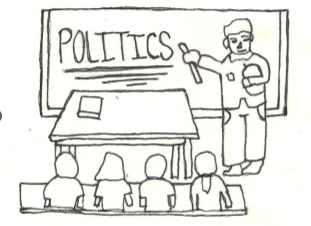
As national politics start to feel more and more local, conversations about these issues are finding their way into the classrooms.
Politics play a significant role in today’s society, and for many teenagers, the current political environment is the only one they know. Schools prepare students to question things and participate in society, but this can raise difficult questions about how- or whether- politics should be discussed within the classroom.
With all the political turmoil in the air these days, it is getting harder and harder to keep opinions at bay. At Oyster River High School (ORHS), students say these discussions can be valuable, while teachers must navigate policies, laws, and the expectation to not push their opinion. So, how do teachers and students balance between the facts, opinions, and neutrality?
In New Hampshire public schools, the “Right to Freedom from Discrimination in Public Workplaces and Education” law was adopted in 2021. This law prohibits public educators from teaching certain concepts related to race, sex, and discrimination, restricting employees that anyone is inherently superior, or that individuals should be treated differently based on protected characteristics.
At the district level, the Oyster River Cooperative School District (ORCSD) has a specific policy called “Controversial Topics, Speakers, and Programs.” The policy states that as long as the controversial issue is discussed in a way that promotes learning, critical thinking, and respect for others’ beliefs, it is supported by the district.
Although these guidelines are in place, the tone of political discussion often comes down to the classroom environment.
Lila Nield (‘27), junior class treasurer, says teachers play a strong role in setting that tone. “The environment that the teacher sets is how the students talk about politics,” Nield says. “they never discourage anyone’s opinion, but if the teacher makes it feel uncomfortable, the students don’t talk about it as much.”
Students such as Caroline Sterndale (‘28) mention how in some classes the teachers are the ones to openly discuss political issues, but in others the topic is avoided. Sterndale says, “For me I go out on my own means and educate myself, but not everyone has that, so school should be a place where you can get a strong, unbiased political education, because now it’s like ‘what isn’t political?’”
Still, educators have to find the balance during open discussions in the class.
J, a teacher wishing to stay anonymous, says, “you need to give kids the ability to exercise their free speech, as long as it doesn’t disrupt the environment.”
Nathan Grove, a social studies teacher at ORHS, also mentions the fact that the times we are living in is all students know, saying “It troubles me that [students] generation has no knowledge of what [politics] used to be.” The constant back and forth of questioning what you can and should say can be difficult, but Grove creates a space where multiple perspectives can be seen, saying, “my policy is to allow all voices to be heard.”
While every classroom approaches political discussion differently, they will continue to shape everyday conversation and affect the lives of both educators and students. As political issues increase, the classroom remains a space where facts, opinions, and neutrality must coexist.
-Bel Ejarque


Leave a Reply